Steps Businesses Take to Improve Email Deliverability in Competitive Environments
By SendBridge Team · Published May 15, 2026 · 11 min read · Email Deliverability
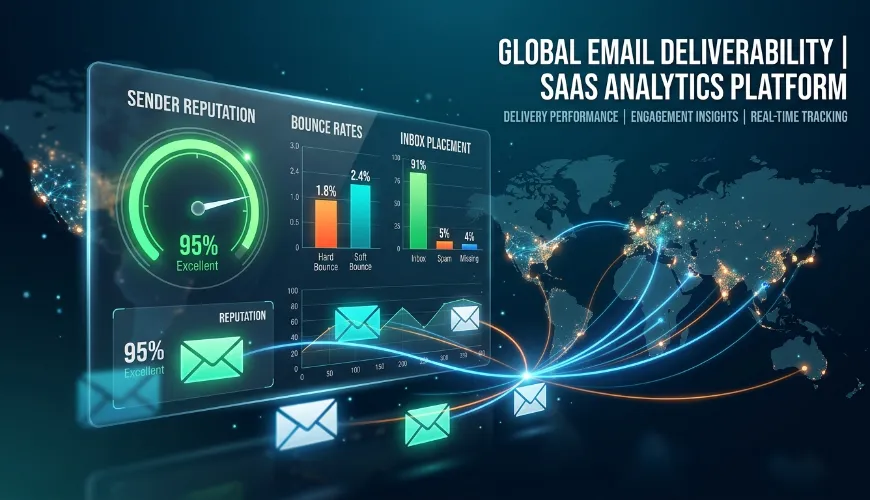
3 million messages per second were received on servers. The vast majority of these disappear. Email deliverability can mean the difference between the success and failure of your outreach in a crowded market. When your content ends up in a junk folder, it's a problem with your design and copy. Large companies view inbox placement as a scientific discipline. They know that the first step in any conversion funnel is to reach the customer. This guide will delve into the mechanics of successful delivery. We discuss the technical procedures, levels of sender trust, and infrastructure requirements needed to ensure your mail reaches where it's supposed to go. Deliverability is the key to digital revenue.
Mechanics of Sender Trust and Reputation
The web's money is trust. Mail servers assign each domain a reputation, which can be viewed as a credit rating for your digital communications. If your score is high, it will be easy to access the main inbox; if it is low, it will disappear from your mail. This reputation is based upon past actions. If your volume is consistent and you have high engagement, you can be sure you are a real business and that you will deliver your messages in the future.
Providers monitor your domain's interactions with recipients to determine authenticity.
- Actions that signal positivity include moving a message to the primary tab or adding a sender to a contact list.
- Negative signals include high bounce rates.
Track these metrics daily, as a slight drop can signal a decline in email deliverability. Clean lists mean keeping your score clean – purge inactive subscribers every 90 days. High engagement and an intact reputation are the messages of this hygiene.
The main factors that affect trust
- Domain Age: Old domains have more provider trust.
- Engagement Rates: When open and click-through rates are high, it indicates high-quality content.
- Response Frequency: When users respond, it helps your domain's reputation.
- Bounce Management: If you repeatedly send to a dead address, your score will go down.
Building a Solid SMTP Infrastructure
Your capacity is determined by the hardware and protocols you're using for your mailings. A small server won't cope with the requirements of a growing business. The SMTP infrastructure provides the stability essential for high-volume sends, optimizing deliverability for each packet. There are specific protocols, such as SPF, DKIM, and DMARC, used in professional settings to verify identity. Without them, your mail isn't accepted by the receiving servers because they don't know you and may think it's a forgery. Authentication is like a digital passport, and filters are now more sensitive to authenticated mail.
- SPF (Sender Policy Framework): Lists the IP addresses allowed for your domain.
- DKIM (DomainKeys Identified Mail): Enables a cryptographic signature for each outgoing send.
- DMARC (Domain-based Message Authentication, Reporting, and Conformance): Defines what to do when emails do not pass SPF or DKIM.
Server configuration is also a factor in technical stability. The rate data leaving the system is controlled in proper setups. When thousands of emails are sent to a provider per second, it triggers alarms. "Throttling" is used to pace your sends, ensure regular communication patterns, and identify issues before the list is impacted. But there are tools available on the market that can help you manage this complexity and ensure your emails are delivered successfully, while your team focuses on strategy.
How to Navigate Modern Spam Filters and Spam Checks
Filters are not simply searching for "trigger" words but for intelligent ones. Modern anti-spam servers are based on machine learning and take your entire context into account. With strict gatekeepers, high deliverability is guaranteed with clean HTML. They analyze ratios between images and texts, link validity, and sentiment of the subject line. As is the typical promotional junk. These automated checks are met by personalization; content that contains specific, relevant information seems more authentic to algorithms.
The quality of content directly influences email deliverability. Don't use caps or too many exclamation points in subject lines – common clues that the email is junk mail. Technical errors, such as broken links or incorrect URLs, can raise warnings and pose a greater threat. All links should point to a trusted, secure domain. Make sure the "From" name is the same each time so users become familiar with your name and are less likely to mark your mail as spam, helping you win over inbox space.
Using the IP Reputation to Create Market Stability
Your online address is important. Each server has an IP address, and the IP reputation of that address affects each email sent from it. There are two options available: shared IP and dedicated IP, and it's a decision that high-volume senders have to make.
- If one company spams, your reputation may be affected if you share the same IP address.
- For businesses that send more than 100,000 emails a month, dedicated IPs offer complete control, with traffic managed only by you.
For new IPs, warm-up is very important. Sudden volume increases are a cause for concern on servers. Begin with small quantities for proven active users and ramp up production over a period of weeks. This creates a history of good relationships, making your IP trustworthy to providers, such as Gmail and Outlook. If this is neglected, it results in low performance. A successful, long-lasting transition is crucial if you manage your email deliverability well during the process. Keep an eye out for temporary delay signs on monitor logs.

Tools You Can Use to Improve Email Performance
Global testing offers a whole-world perspective. Companies rely on a cheap proxy to check the look of content across regional networks and ensure regional deliverability. This audit infrastructure operates on nodes outside the office and determines whether a regional provider is blocking images or whether a layout fails on a given mobile network. Checking information guarantees all subscribers have the same experience.
In addition to tracking open rates, one should also track "inbox placement" when monitoring email performance. Open rates indicate who opened the email, not who saw it. Specialized tools simulate sending messages to "seed lists" for each major provider and tell you whether they end up in the Junk, Inbox, or Promotions folders.
The sudden drop in certain providers can be used to investigate updates to the algorithms or email deliverability problems caused by unique configuration errors on the platform.
Performance benchmarks for success
| Metric | Target | Impact |
|---|---|---|
| Bounce Rate | Under 2% | Maintains domain health. |
| Flag Rate | Under 0.1% | Prevents provider blocks. |
| Placement | Over 90% | Ensures campaign visibility. |
| Unsubscribe | Under 0.5% | Indicates content quality. |
Improving Reach Through Marketing Automation & CRM
Growth requires systems. Marketing automation delivers the right content at the right time and dispatches based on user behavior. High-accuracy CRM data ensures high deliverability at scale. Automatic responses to actions – e.g., visiting a pricing page or downloading a white paper – create a sense of support. What matters most for delivering your emails successfully is high relevance, which translates into high engagement.
Integration guarantees accuracy. Syncing mailing software with CRM systems ensures that information is up to date. It's important that unsubscribes appear in your CRM right away; otherwise, those who have unsubscribed will be marked.
This is the very basic part of clean records. Most tools have list hygiene options that eliminate addresses that bounce back and forth. This proactive management helps keep your sender score in check by filtering out database noise.
Carrying Out High-Impact Outreach Campaigns
These outreach programs lack established relationships, making cold contact difficult. Protect deliverability by checking each contact before sending, since each recipient could be a critic. Technical requirements are higher. A warm domain with a good history is required – new domains do not work. Secondary domains are used to protect the primary domain for businesses, isolate risk, and still allow them to grow competitively.
Make sure not to overproduce and not compromise on quality. It's dangerous to send 5,000 cold emails from one account per hour. Modern email deliverability strategies include what is called 'rotating' the account, which means distributing the email load across several accounts to keep the profile low. This is a typical sales team activity. A certain number of messages per day are sent from each account, without exceeding provider limits, and with a large audience reached. Personalize each send for the industry or recipient's needs to get the best response rate. Email automation schedules that span multiple time zones work effectively.
Optimization of SaaS Marketing Tools for Communication
Transactionals are the lifeblood of SaaS businesses. SaaS tools may process both marketing and transactional traffic, but traffic separation means that marketing issues won't affect transactional traffic. Have distinct subdomains of your domain name for each type (for example, "mail.yourcompany.com" for newsletters, "info.yourcompany.com" for alerts). This separation helps safeguard vital business processes, even if a marketing blast results in a brief drop in email delivery.
Transparent reporting is essential for data-driven decisions. Now there are tools that can be used to send statistics via an API. This can be piped into internal dashboards so that a funnel can be monitored in real time. Do you have product sign-ups from your email campaigns? By measuring the click-through path, you will know the real impact of your work. This is enough to make higher-level delivery services worth investing in, because the more you can get, the better your revenues will go.
Recommended stack for growth:
- HubSpot and Salesforce – for managing contact records.
- SendGrid or Amazon SES – to scale infrastructure.
- ZeroBounce or NeverBounce – list cleaning.
- Litmus or Email on Acid – rendering checks.
Analysis of the Statistics of the Global Mailing Trends
According to statistics, 1 in 5 emails do not get delivered to the inbox. Providers are competitive, as 376 billion emails are sent globally every day in 2025. To remain in the "good" traffic, more than the standard requirement must be accomplished. Engaging with your audience shows gatekeepers your value, which helps maintain a good email deliverability score.
Timing matters. Try to avoid rush hours, such as Tuesdays at 9:00 AM. Sending e-mails during off-peak hours increases the likelihood that they will be delivered. Try to go with weekend or late-night slots – it might be the time when your audience is listening. Over time, small adjustments can yield big performance gains.
Actual Costs of Implementation
Professional email services charge fees based on volume. The standard plan for 50,000 emails/month is $15-$40, and the high-end enterprise plans with special support are more than $450. Think about the consequences of failure: lost inboxes mean acquisition costs skyrocket. Invest in tools \= income.
Infrastructure needs training. Your staff should know how to read the DMARC report and bounce logs, and respond swiftly when things go wrong. Read the email deliverability guide to learn about the technical requirements. This means you will be able to avoid any future issues as the digital landscape shifts.
Average monthly expenses of scaling teams
- Startup: $15-$50 (up to 100k emails).
- Growth: $100-$300 (up to 500k emails).
- Enterprise: $450+ (custom volumes and dedicated IPs).
Automated Sequences: Strategic Refinement
Efficiency is nothing but logic. Create 'nurture' sequences using automation tools – smaller, more targeted emails that lead users through a process as opposed to a single large blast. This helps keep domains live and engagement rates steady, rather than the 'cold turkey' approach. Consistency enables providers to anticipate and understand behavioral patterns.
One of the fundamental elements of email deliverability is A/B testing. Look at test subject lines for opens – high rates are good signs that they have valuable content. The deliverability status is directly affected by the engagement test. Low opens could indicate that the providers are not prioritizing your mail. Give people a simple way to get off your list – unsubscribing is better than flagging it.
Engagement benchmarks by sector
| Industry | Open Rate | CTR |
|---|---|---|
| SaaS/Tech | 21.0% | 2.5% |
| E-commerce | 15.6% | 2.1% |
| Education | 28.1% | 4.1% |
Wrap-up of Inbox Mastery
Getting it to the inbox means attention to detail and user preferences will be required constantly. With a focus on email deliverability, you'll know that your voice is being heard. Careful watching helps to achieve long-term objectives. Utilize audit infrastructure, clean records, and build a reputation on trust. Treat the inbox with respect, and it will treat you the same way. If you want to expand your reach beyond the inbox, you might consider how to text from gmail to ensure your messages are seen immediately by your audience.