Too Many Sales Tools? Here's How to Pick the Right One
By SendBridge Team · Published Jun 15, 2026 · 9 min read · Sales

Sales software spending has climbed steadily through 2024 and 2025. The average rep now has access to more dashboards, dialers, and data platforms than at any point before. And yet quota attainment rates across B2B sales have either stalled or declined in the same period.
The contradiction is real. More tools, worse results. The problem usually isn't the category of tool a team chooses - it's the number of tools they're trying to run simultaneously. This article looks at why tool overload measurably hurts sales performance, what conversation intelligence actually does that basic CRM doesn't, and how to find a platform that fits a real budget and a real team. If your current setup feels overwhelming, you should examine how an IT CEO successfully reduced a bloated sales tool stack without losing critical data to simplify your operations.
The Real Cost of Too Many Sales Tools

The numbers here are hard to ignore. Salesforce's 2024 State of Sales Report - based on 5,500 respondents across 27 countries - found that the average rep uses eight separate tools to close a single deal. That same report found reps spend only 28 to 30% of their workweek on actual selling. The remaining 70% goes to administrative work, data entry, and switching between applications.
That's before you get to what tool overload does to quota performance. A Gartner survey, reported by Harvard Business Review in August 2023, found that sellers who feel overwhelmed by their technology stack are 43% less likely to meet quota. Nearly half of salespeople in that survey reported feeling overwhelmed by the tools they're required to use.
And the market knows this is a problem. Salesforce's 2024 report also found that 84% of sales teams without a consolidated platform plan to reduce the size of their tech stack. That's not a fringe view - it's the majority position among teams living with the consequences right now.
Every added tool means another set of logins, another onboarding cycle, and more context-switching during selling hours. The compounding cost isn't just the subscription fee. It's the time and the deals that get lost in the gaps between platforms. Among all these sales tools, a time blocking tool helps sales teams protect focus time and avoid constant context switching between platforms.
This is exactly why conversation and revenue intelligence emerged as a category worth paying attention to. Teams tired of paying for platforms they only partially use have started looking for an affordable alternative to Gong - something that covers the features that actually move deals without the enterprise overhead. The pitch isn't "add this to your stack." It's "replace several things you already have with one that does more."
What Conversation Intelligence Actually Does
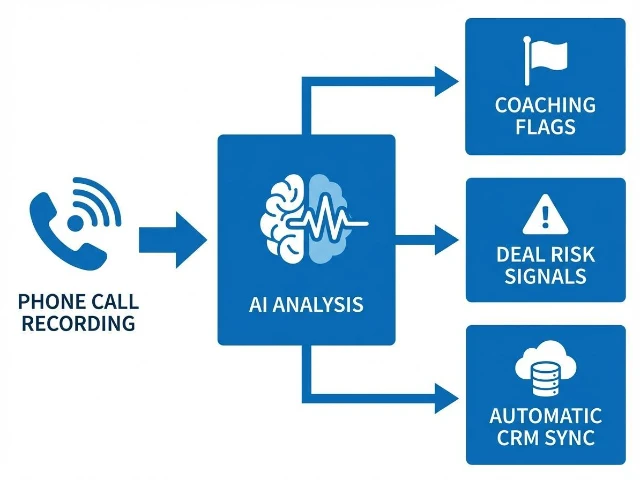
Plain definition: conversation intelligence software records, transcribes, and analyzes sales calls and emails to surface coaching signals, deal risks, and buyer intent data. It then syncs that information automatically to your CRM so reps don't have to do it manually.
That last part matters more than most buyers realize. Basic CRM stores what happened - a call took place via a VoIP provider like Quo, a note was added if the rep remembered, a stage was updated. Conversation intelligence reads the actual interactions and flags what's worth acting on: a prospect mentioned budget constraints on a call, a competitor came up twice, a deal hasn't had a two-way conversation in 14 days. Those are the signals that change what a rep does next.
The core functions worth paying for: call recording and transcription with reliable accuracy, deal health scoring, coaching flags, automatic CRM logging, and email open and reply tracking. Any credible platform in this category covers all five.
For growth-stage teams specifically, the coaching angle matters most. Small teams don't have a dedicated sales coach or a RevOps manager reviewing call recordings every week. A well-configured conversation intelligence tool fills that role - flagging when a rep talks more than listens, when discovery questions are skipped, when a deal shows early signs of going cold. Combining that with AI-driven lead generation strategies can meaningfully improve pipeline quality without adding headcount.

Why Gong Isn't the Only Option - And Often Isn't the Right One
Gong is built for large revenue organizations. Teams with dedicated RevOps functions, enterprise CRM configurations, and the bandwidth to manage a complex implementation. The pricing and onboarding requirements reflect that market.
Most SMB and growth-stage teams don't operate that way. They don't have a RevOps team standing up the integration or a sales enablement function managing ongoing coaching programs. They end up paying for a full enterprise license and using maybe 40% of the feature set - while the rest sits idle and the contract renews anyway.
That's what makes affordable alternatives to Gong worth understanding: the core value of conversation intelligence doesn't require enterprise-tier spend to deliver. Call intelligence, CRM integration, and email tracking - the features that actually move deals forward - are available at a fraction of the enterprise cost from platforms built for smaller teams.
The performance data supports this. The Salesforce 2024 State of Sales research found that 83% of teams using AI-powered sales tools saw revenue growth, compared to 66% of teams that weren't. A 17-point gap. And it doesn't require an enterprise contract to capture it - the technology benefit is available across price tiers.
The right question for a buyer evaluating this category isn't "which tool has the most features." It's "which features does this team actually open every week." A $200-per-seat platform with five features reps use daily beats a $600-per-seat platform with 30 features reps avoid every time.
What to Look for When Choosing a Gong Alternative
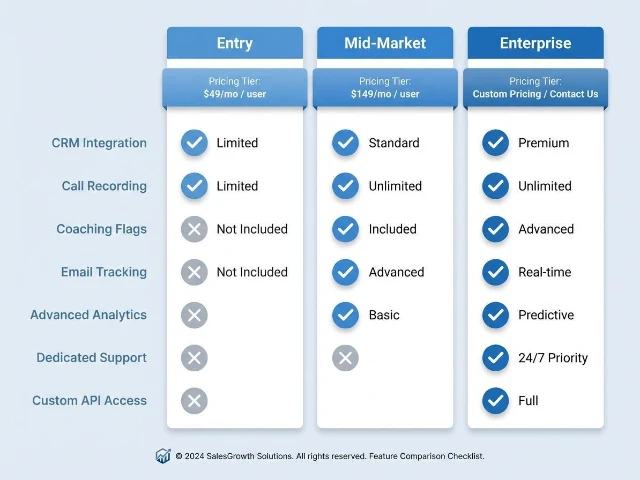
A few specific things worth checking before signing anything:
- CRM integration depth. Does it sync automatically, or does the rep have to manually log calls and update fields? If it requires manual steps, adoption will collapse within 60 days. Reps will stop using it. Check whether the sync is bi-directional and whether it handles your specific CRM version.
- Transcription accuracy. This is the core function. If it can't reliably transcribe calls - including calls with background noise, non-native speakers, or technical jargon - the AI outputs built on top of that transcription will be unreliable. Ask for a pilot call before committing.
- Coaching and deal risk flags. Archiving calls is the minimum bar. What you actually need is a system that surfaces insights from those calls without a manager having to listen to every recording. If the platform doesn't do this automatically, you're paying for storage.
- Pricing model transparency. Per-seat pricing has very different implications for a team that's growing than flat-rate licensing does. Enterprise tools often penalize headcount growth. Run the math at your projected team size 12 months from now, not just today's headcount.
- Onboarding timeline. A tool that takes 90 days to implement destroys the ROI case before it starts. Ask the vendor directly how long median onboarding takes for teams your size - not enterprise deployments, your size.
Harvard Business Review's March 2024 analysis on integrating digital tools into sales strategy makes this point clearly: effective adoption combines human judgment with targeted software assistance. Technology should support rep decision-making, not replace it. A platform that buries reps in AI-generated outputs without context quickly trains them to ignore the alerts entirely.
Pairing a conversation intelligence tool with automation workflows that reduce manual work is where real productivity gains compound. Time reclaimed from admin tasks means more conversations, more pipeline, and more closed deals.
How to Run a Pilot Before You Commit
Don't pilot with sales management. Pilot with actual reps - the people who will decide within two weeks whether the tool is worth opening each morning. Management almost always says adoption will happen. Reps vote with their behavior.
Run the pilot for 30 days and measure three things: time saved on note-taking and CRM logging per rep per week, call review rate (are reps actually watching flagged recordings?), and deal stage progression velocity for opportunities touched by the tool versus those that weren't.
Check the integration documentation before signing. If connecting to your CRM requires custom development work, the real cost of the tool is not what's on the quote. It's the quote plus engineering time plus the delay before you see any return.
Ask one specific question during vendor evaluation: "What percentage of your current customers are teams under 20 reps?" A tool built primarily for enterprise accounts will have thin customer success resources, documentation, and support for smaller teams. The answer tells you more than any feature comparison sheet.
Be skeptical of demos built around capabilities you'll never touch. Demos are designed to impress, not to reflect your team's actual day-one workflow. Ask the vendor to walk through what your reps will do on day one, not the advanced analytics suite no one opens until month six.
Connecting your outreach tools to a broader revenue strategy matters here too. Email tactics that connect to revenue goals work best when the underlying sales intelligence platform feeds signal back into how and when your team reaches out.
Tools That Truly Make a Difference
Sales technology should reduce friction. That's the only benchmark worth applying when evaluating any new platform. If a tool adds logins, training cycles, and dashboard management to a rep's day without removing something else, it's making the problem worse.
The goal is more time in front of buyers. Not more time managing software.
Salesforce's 2024 State of Sales data puts it simply: the highest-performing teams aren't the ones with the most tools - they're the ones with the right ones. The gains are real, but they only happen when the tool actually gets used. That means the buying decision has to prioritize fit and adoption rate over raw feature count.
Teams that consolidate around focused, well-integrated tools consistently outperform those that keep accumulating platforms. An affordable conversation intelligence tool that matches a team's actual size and workflow will deliver better returns than an enterprise platform reps actively avoid opening.
The best sales tool is the one your team uses every day without being told to. That's the only proof of value that matters.