Top 10 AI CRM Tools to Boost Sales Performance
By SendBridge Team · Published Sep 25, 2026 · 25 min read · Sales

Ask any sales rep what eats most of their day and the answer is rarely "selling." It's the emails that need logging, the follow-ups that slipped through the cracks, the pipeline reviews that turn into hour-long data cleanup sessions. Meanwhile, the quota clock keeps ticking. This is the quiet dysfunction that lives inside most sales organizations, and it's exactly the problem AI CRM was built to solve.
The math here is pretty straightforward. A rep who spends 40% of their week on admin is only really selling for three days out of five. Cut that admin time in half through automated data capture, smart follow-up sequences, and AI that tells you which deals actually deserve attention - and suddenly that same rep is producing at a meaningfully higher level without working any harder. That's not a technology pitch. That's just what happens when the right tools get out of people's way.
But not every AI CRM delivers equally, and picking the wrong one is its own kind of tax on your team's time. Some platforms are genuinely transformative. Others bolt the word "AI" onto a feature list that hasn't changed since 2019. This guide cuts through that noise. We've broken down 10 of the best modern AI CRM platforms - what they actually do, who they're built for, and whether they're likely to make a real difference to how your team operates.
Let's get into it.
What Makes an AI CRM Different from a Traditional CRM?
Traditional CRMs were built to store information. AI-based CRMs are built to act on it. In parallel, healthcare teams are adopting solutions like AI front desk for clinics to automate patient communication, appointment scheduling, and front-office workflows. The distinction matters enormously for sales teams trying to maximize every hour of the working day. Here are the capabilities that set AI CRMs apart:
Predictive Lead Scoring
AI models analyze behavioral signals, engagement history, firmographic data, and conversion patterns to rank leads by their likelihood to close, ensuring accuracy through AI model testing services. Reps stop wasting time on long shots and focus energy where it counts most.
Intelligent Workflow Automation
Automated sequences trigger follow-up emails, task reminders, and stage progressions based on deal activity. Reps are guided through the sales process without relying on memory or manual scheduling.
AI-Powered Forecasting
Rather than relying on rep-reported pipeline confidence, AI forecasting models assess actual deal health, historical win rates, and engagement signals to produce accurate revenue projections that leadership can trust.
Automated Data Entry
AI captures and logs calls, emails, and meeting notes automatically. CRM tools records stay up to date without reps spending time on manual data input, which means cleaner data and more selling time.
Real-Time Performance Dashboards
Managers gain live visibility into rep activity, pipeline health, and conversion rates. Performance gaps surface immediately, enabling coaching conversations that are timely, specific, and data-driven.
How AI CRM Improves Sales Performance
The performance benefits of AI CRM extend across the entire sales operation, from individual rep efficiency to organization-wide forecasting accuracy.
Reduces Manual Administrative Work
Studies consistently show that sales reps spend a significant portion of their week on non-selling tasks such as updating records, writing follow-up emails, and scheduling calls. AI-powered CRM automates these activities, giving reps time back to focus on revenue-generating conversations.
Improves Follow-Up Consistency
One of the most common failure points in a sales process is inconsistent follow-up. AI CRM platforms automate reminders and sequences so that no lead goes cold due to a missed touchpoint. Every prospect receives timely, relevant outreach regardless of how busy the rep is.
Enhances Visibility into Rep Performance
Managers can track activity metrics, pipeline progression, and conversion rates at the individual rep level. This visibility makes performance reviews more objective and coaching conversations more productive.
Automates Repetitive Sales Tasks
From sending introductory emails to updating deal stages based on email replies, AI-based CRM eliminates the repetitive manual actions that slow reps down and introduce human error into the pipeline.
Provides Real-Time Analytics
Rather than waiting for end-of-month reports, sales leaders get live dashboards that reflect current pipeline health, forecast accuracy, and rep activity. This enables faster decisions and more proactive management.
Top 10 AI CRM Tools to Boost Sales Performance
No two sales teams are exactly alike - different sizes, different sales cycles, different operational challenges. The best AI CRM platforms on the market today - including Creatio, Salesforce Einstein, HubSpot CRM, Zoho CRM, Microsoft Dynamics 365 Sales, Pipedrive, Freshworks CRM, SAP Sales Cloud, Monday Sales CRM, and Insightly - reflect that diversity.
Some are built for lean, fast-moving SMB teams that need to get up and running quickly. Others are designed for enterprise organizations managing complex pipelines across multiple regions and product lines. What unites them is a strong commitment to embedding AI directly into the sales workflow to improve prioritization, forecasting, automation, and overall performance.
For teams looking to evaluate options more deeply, exploring best AI CRM tools can help identify platforms that align with specific sales processes, automation needs, and business size.
Here's how they stack up.
1. Creatio
Overview
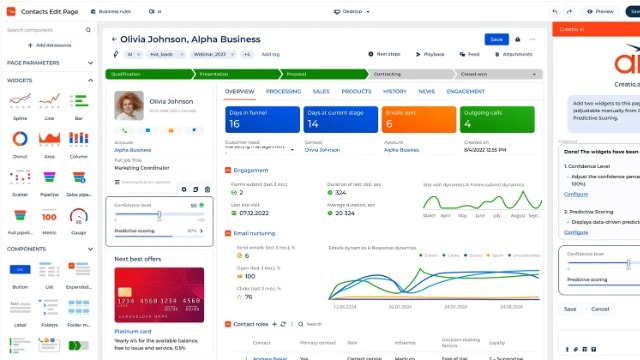
Creatio is an AI CRM platform that unifies sales, marketing, and service operations on a single no-code foundation. What sets it apart is how deeply AI is embedded into its core, giving it full awareness of every data object, workflow, and business process across the system. By combining a fully customizable CRM with a powerful business process engine, Creatio CRM delivers exceptional flexibility for sales teams seeking custom automation without relying on deep technical resources.
Key AI Features
-
No-code AI workflow builder for automated sales processes
-
Predictive lead scoring driven by machine learning models
-
Pre-built AI agents for sales (account research, quote generation, meeting prep, follow-ups), marketing (content creation, email campaigns, lead nurturing), and service (case management, knowledge base, customer support)
-
No-code AI Agent Builder for creating and deploying custom agents without technical expertise
-
AI Command Center for centralized monitoring, governance, and control of all agents and AI skills
Best For
Creatio is best suited for enterprise and mid-market organizations that need a highly customizable CRM with serious AI depth. It is particularly strong for organizations with complex, multi-stage sales cycles.
Why It Improves Sales Performance
The AI agent layer is where Creatio pulls ahead for enterprise teams. Rather than simply surfacing recommendations for reps to act on, Creatio's agents can handle entire workflows autonomously - researching accounts before a call, generating quotes, drafting follow-up emails, and managing lead nurturing sequences without human intervention. Sales ops teams can build and modify these agents through a visual no-code environment, which means processes can evolve quickly as the business changes. Managers gain a clear view of both human and agent activity through the AI Command Center, making performance oversight more complete than in any traditional CRM setup.
Pros
-
Highly flexible no-code customization with minimal IT dependency
-
Agentic AI that works autonomously across sales, marketing, and service functions
-
Excellent for scaling complex, multi-team sales operations
-
Robust reporting and real-time performance tracking
-
700+ pre-built integrations and connectors across 20+ industry-specific solutions
Potential Limitations
-
Initial setup and configuration can be time-intensive for complex processes
-
The breadth of features may feel overwhelming for smaller teams
-
Pricing scales with usage, which can add up for large deployments
2. Salesforce Einstein
Overview
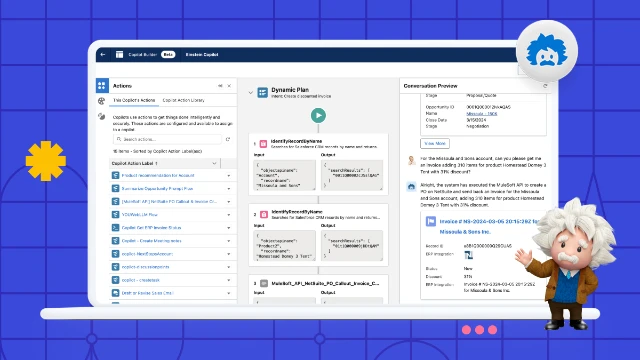
Salesforce Einstein is the AI layer embedded across the Salesforce platform, transforming their CRM into an intelligent sales engine. Einstein brings predictive scoring, automated insights, and conversational AI directly into the Salesforce interface that millions of reps already use daily.
Key AI Features
-
Einstein Lead Scoring and Opportunity Scoring powered by ML
-
Einstein Conversation Insights for call analysis and coaching flags
-
AI-generated email drafts and next-step recommendations
-
Predictive forecasting with pipeline health signals
-
Einstein GPT for generative AI across the sales workflow
Best For
Salesforce Einstein is best for enterprise organizations and mid-market teams already invested in the Salesforce ecosystem. It delivers the highest ROI when built on top of an established, well-maintained Salesforce org.
Why It Improves Sales Performance
Einstein eliminates guesswork from prioritization. Reps see which leads to call first, which deals are at risk, and what actions are most likely to advance an opportunity. Managers get AI-surfaced coaching opportunities rather than having to manually review every call recording or pipeline update.
Pros
-
Deeply integrated into an ecosystem most enterprise teams already use
-
Best-in-class breadth of AI features across the full sales lifecycle
-
Continuous improvement through Salesforce's AI research investment
-
Einstein GPT accelerates content creation and rep efficiency
-
Highly scalable across complex organizational structures
Potential Limitations
-
High total cost of ownership, especially with add-ons and Einstein licenses
-
Requires a well-maintained CRM foundation to deliver accurate AI outputs
-
Complexity of the platform often requires dedicated Salesforce admins
3. HubSpot CRM
Overview
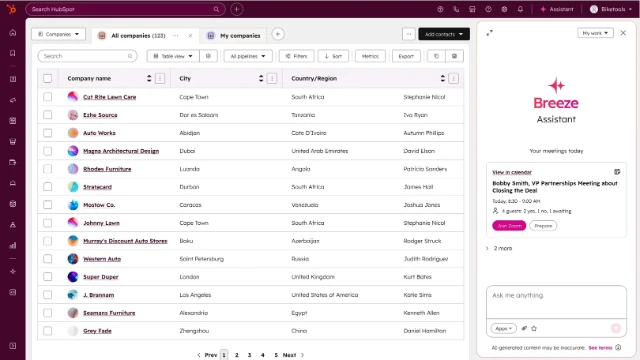
HubSpot CRM has grown from a marketing-focused tool into a comprehensive AI-powered sales platform trusted by businesses of all sizes. Its free tier and intuitive interface make it one of the most accessible entry points into AI-assisted selling, while its paid tiers unlock advanced automation and intelligence capabilities.
Key AI Features
-
AI-powered lead scoring based on engagement and behavior data
-
Breeze AI for automated email drafts, meeting summaries, and rep assist
-
Predictive deal health scoring across the pipeline
-
Automated sequences and follow-up task management
-
Conversation intelligence with call transcription and coaching insights
Best For
HubSpot is best for SMBs and growing mid-market teams that need a polished, user-friendly CRM with solid AI capabilities out of the box. Teams that rely heavily on email communication may also want to explore a dedicated CRM for Gmail, which offers deeper inbox integration than most general-purpose platforms provide.
Why It Improves Sales Performance
HubSpot reduces friction at every stage of the sales process. Reps receive AI-suggested next steps, automated follow-up sequences run in the background, and conversation intelligence helps managers coach without listening to every call. The unified platform means sales activity is automatically tied to marketing touchpoints, giving reps richer context for every conversation.
Pros
-
Intuitive interface with a low learning curve for new users
-
Free CRM tier provides genuine value before any paid commitment
-
Strong alignment between sales, marketing, and service data
-
Breeze AI delivers practical day-to-day productivity improvements
-
Excellent ecosystem of integrations with third-party tools
Potential Limitations
-
Advanced AI features require higher-tier paid plans
-
Can become costly as teams scale and feature needs grow
-
Reporting customization is limited compared to enterprise CRMs
4. Zoho CRM
Overview
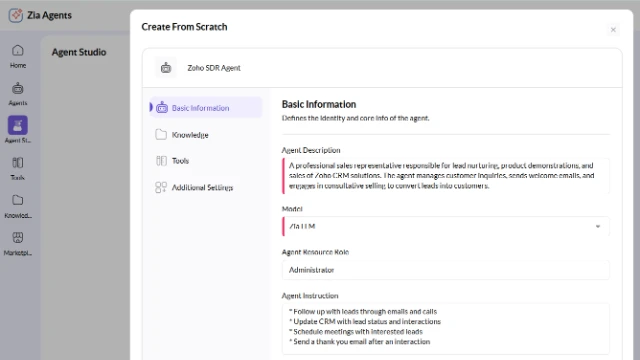
Zoho CRM is a feature-rich, cost-effective AI CRM platform that delivers enterprise-grade capabilities at a price point accessible to small and mid-sized businesses. Its built-in AI assistant, Zia, provides intelligent recommendations, anomaly detection, and predictive analytics directly within the CRM workflow.
Key AI Features
-
Zia AI for lead and deal scoring, trend analysis, and anomaly alerts
-
Predictive sales forecasting with scenario modeling
-
Automated workflow triggers based on CRM activity signals
-
Email sentiment analysis and best-time-to-contact recommendations
-
AI-powered sales assistant with voice and chat query support
Best For
Zoho CRM is best for SMBs and cost-conscious mid-market organizations that want broad AI functionality without the price tag of Salesforce or Microsoft. It is also strong for teams already using other Zoho suite products.
Why It Improves Sales Performance
Zia's proactive intelligence keeps reps focused on the right activities at the right time. Anomaly detection flags unusual pipeline drops before they become problematic, while best-time-to-contact features improve outreach effectiveness. Managers benefit from forecasting accuracy improvements that reduce the guesswork in revenue planning.
Pros
-
Strong value-to-cost ratio with AI features available at lower price tiers
-
Zia provides actionable, practical AI assistance without complexity
-
Deep integration with the broader Zoho product suite
-
Flexible enough for diverse industry use cases
-
Active development cycle with frequent feature updates
Potential Limitations
-
Interface can feel cluttered given the breadth of available features
-
Customer support response times can be inconsistent
-
AI capabilities lag behind Salesforce and Microsoft at the high end

5. Microsoft Dynamics 365 Sales
Overview
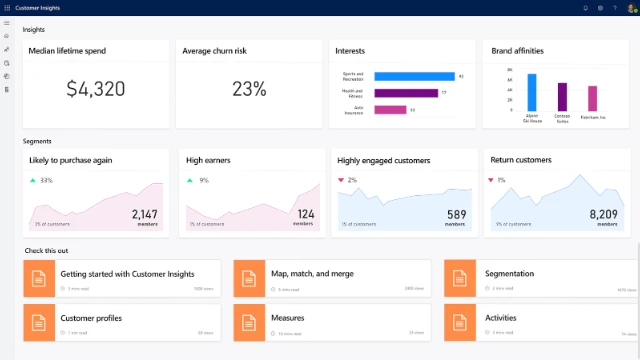
Microsoft Dynamics 365 Sales is an enterprise-grade AI CRM deeply integrated with the Microsoft 365 ecosystem. Its Copilot capabilities bring generative AI directly into the sales workflow, automating communication, surfacing deal insights, and connecting CRM data with the productivity tools sales teams already use every day.
Key AI Features
-
Copilot for Sales with AI-generated email drafts and meeting summaries
-
Relationship Intelligence powered by LinkedIn Sales Navigator integration
-
Predictive lead and opportunity scoring with win probability modeling
-
Conversation Intelligence for call transcription, analysis, and coaching
-
Real-time pipeline health dashboards with AI-surfaced risk flags
Best For
Dynamics 365 is best for enterprise and large mid-market organizations already embedded in the Microsoft ecosystem. Teams using Teams, Outlook, and Azure gain the most value from native integrations that reduce context switching.
Why It Improves Sales Performance
Copilot for Sales creates meaningful efficiency gains by automating the most time-consuming communications tasks. Reps receive AI-drafted emails and call summaries that require light editing rather than creation from scratch. LinkedIn integration enriches CRM records automatically, giving reps better context before every interaction and reducing manual research time significantly.
Pros
-
Native integration with Microsoft 365, Teams, and LinkedIn
-
Copilot AI is among the most capable generative AI sales assistants available
-
Enterprise-grade security and compliance infrastructure
-
Strong relationship intelligence capabilities via LinkedIn
-
Scalable across large, complex organizational structures
Potential Limitations
-
High cost and implementation complexity for smaller organizations
-
Requires significant admin expertise to configure and maintain effectively
-
Less intuitive for teams without an existing Microsoft technology foundation
6. Pipedrive
Overview
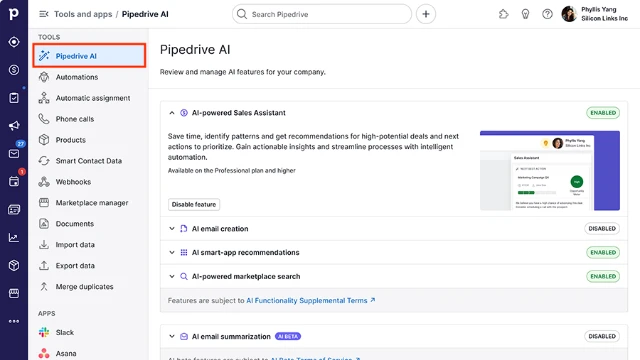
Pipedrive is a sales-focused CRM built around visual pipeline management and practical AI assistance. Its AI Sales Assistant and automation features are designed to keep reps moving deals forward without unnecessary complexity, making it one of the most user-friendly options for teams that value simplicity alongside intelligence.
Key AI Features
-
AI Sales Assistant for deal recommendations and next-step suggestions
-
Lead scoring and deal health indicators based on activity patterns
-
Smart email tools with AI-powered composition suggestions
-
Automated workflows triggered by pipeline stage changes
-
Sales forecasting with revenue projection dashboards
Best For
Pipedrive is best for SMBs and sales-focused teams that want an intuitive, pipeline-centric CRM with practical AI features. It performs especially well for teams with straightforward, repeatable sales processes.
Why It Improves Sales Performance
Pipedrive keeps reps focused on moving deals through the pipeline by surfacing AI recommendations for which opportunities need attention and what action to take next. Its visual interface makes pipeline management fast and intuitive, reducing the time reps spend navigating the CRM and increasing the time they spend acting on it.
Pros
-
Exceptionally intuitive interface with low onboarding friction
-
Visual pipeline management that maps naturally to sales workflows
-
AI Assistant provides actionable, day-to-day guidance for reps
-
Strong automation capabilities for follow-up and task management
-
Transparent, affordable pricing suitable for growing teams
Potential Limitations
-
Less suitable for complex, enterprise-scale sales operations
-
Reporting and analytics depth lags behind larger platforms
-
Limited built-in marketing capabilities compared to all-in-one tools
7. folk CRM
Overview
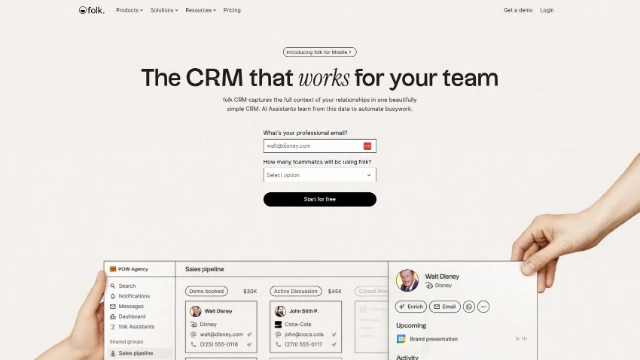
folk CRM is a lightweight AI CRM built for teams that want to manage relationships and sales pipelines without spending weeks configuring their workspace. It brings contacts, companies, conversations, deals, and outreach into one clean interface.
Where folk stands out is its ability to turn scattered relationship data into useful context. Teams can capture prospects from LinkedIn with the folkX extension, sync email, calendar, and WhatsApp conversations, and use AI to prepare personalized outreach or fill missing CRM fields.
Key AI Features
- AI assistants that summarize interactions and help teams act on relationship data
- Magic Fields that research, categorize, and enrich contacts using custom prompts
- AI-generated email icebreakers and personalized outreach
- Next Best Action recommendations based on existing CRM context
- Contact enrichment and automated data organization
- MCP access for connecting folk data with AI tools such as ChatGPT, Claude, Cursor, and VS Code
Best For
folk is best for startups, agencies, recruiting teams, investors, consultants, and small sales teams that rely heavily on personal relationships. It is particularly useful for teams sourcing leads through LinkedIn or managing contacts across email, calendar, and WhatsApp.
Why It Improves Sales Performance
folk removes much of the routine work that causes sales teams to neglect their CRM. New contacts can be captured from LinkedIn, enriched, grouped, and added to a pipeline without repetitive copying and pasting.
Its AI features also help reps use the information already stored in the CRM. Instead of reading through old notes and email threads before every follow-up, they can generate summaries, identify the next action, and draft a message based on the relationship's actual history. This makes personalized outreach easier to maintain as the pipeline grows.
Pros
- Fast setup and a clean interface with little onboarding required
- Strong LinkedIn prospecting workflow through the folkX extension
- Email, calendar, and WhatsApp synchronization
- Flexible pipelines for sales, recruiting, partnerships, and fundraising
- AI enrichment and personalization features available inside the CRM
- Built-in email campaigns and multi-step sequences
- MCP server and API access for advanced AI and automation workflows
Potential Limitations
- Reporting and forecasting are less advanced than those offered by enterprise CRMs
- Not designed for highly complex sales organizations with extensive approval layers
- Some features, including email sequences, dashboards, and API access, require a higher-tier plan
8. BIGContacts
Overview
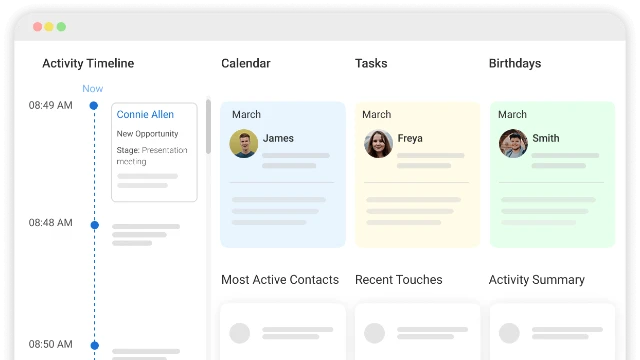
BIGContacts is an AI-native CRM built specifically for small and mid-sized businesses that need intelligent sales automation without the complexity of enterprise platforms. Its AI layer is woven directly into contact management, pipeline tracking, email marketing, and reporting, giving growing teams a unified system that actively works alongside them rather than just storing data.
Key AI Features
- AI Campaign Designer that generates full email campaigns from a goal and audience description
- AI Email Writing Assistant for tone refinement, content improvement, and message sharpening
- AI-powered dashboard with lead scoring, inactive contact flagging, and conversion pattern identification
- AI Pipeline Tracker that monitors deal stages and surfaces stalled opportunities before they go cold
- AI Report Summaries that instantly extract key insights when a report is opened
- AI Search for instant retrieval of contact details and scattered information across the CRM
Best For
BIGContacts is best for small businesses and growing SMB teams that need a capable, AI-powered CRM without the overhead of Salesforce or HubSpot. It is especially strong for teams where the same person manages contacts, email outreach, and pipeline tracking simultaneously.
Why It Improves Sales Performance
BIGContacts reduces the manual work that slows small teams down most. AI handles campaign creation, follow-up timing, and pipeline monitoring automatically, so reps stay focused on conversations rather than CRM upkeep. The AI dashboard tells teams exactly where to direct their attention each day, replacing prioritization with data-surfaced direction.
Potential Limitations
- No downloadable or on-premise version available for teams with self-hosting requirements
- Dark user interface mode is not currently supported
- Free plan does not include a dedicated account manager, unlike paid tiers
9. SAP Sales Cloud
Overview
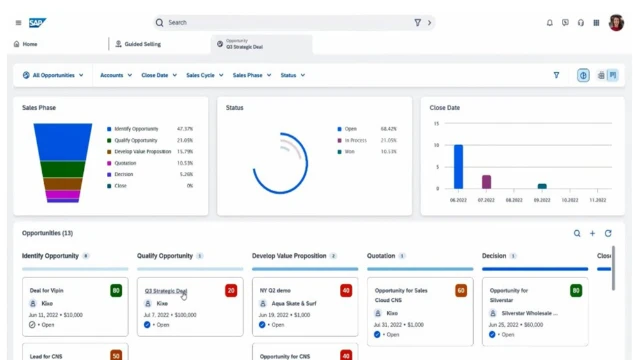
SAP Sales Cloud is an enterprise CRM platform built for organizations operating at scale across complex, global sales environments. Its AI capabilities focus on guided selling, intelligent forecasting, and deep integration with ERP and back-office systems, making it a natural choice for large enterprises with complex quote-to-cash requirements.
Key AI Features
-
AI-driven guided selling with next-best-action recommendations
-
Intelligent forecasting integrated with SAP ERP and financial data
-
Conversation intelligence for call analysis and coaching
-
Predictive pipeline analytics with deal risk scoring
-
AI-powered product and pricing recommendations during the sales process
Best For
SAP Sales Cloud is best for large enterprises, particularly those already running SAP ERP, S/4HANA, or other SAP back-office systems. It excels in industries such as manufacturing, distribution, and professional services with complex CPQ requirements.
Why It Improves Sales Performance
SAP Sales Cloud bridges the gap between front-office sales activity and back-office financial data. Reps receive guided selling recommendations informed by inventory, pricing, and margin data from ERP systems, enabling them to close deals that are both commercially sound and operationally feasible. Forecasting accuracy benefits from this integration, reducing the gap between pipeline projections and realized revenue.
Pros
-
Deep integration with SAP ERP delivers unmatched back-office connectivity
-
AI guided selling recommendations are enriched with operational data
-
Enterprise-grade security, compliance, and data governance capabilities
-
Strong support for complex, multi-tier sales organizations
-
Excellent for industries where product configuration and pricing are complex
Potential Limitations
-
High implementation cost and lengthy deployment timelines
-
Requires significant SAP expertise to configure and optimize
-
Less suitable for organizations outside the SAP ecosystem
10. Monday Sales CRM
Overview
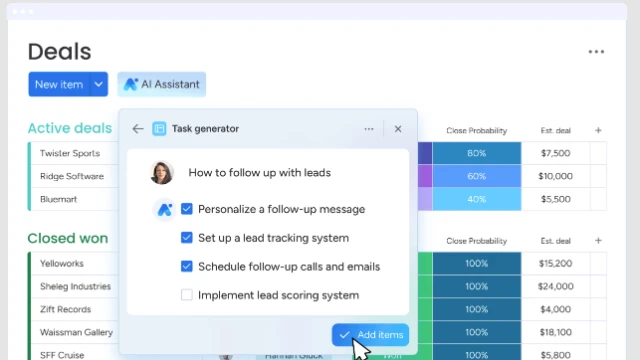
Monday Sales CRM extends the popular Monday.com work operating system into a flexible, visually intuitive sales management platform. Its AI features focus on automating data entry, surfacing activity insights, and streamlining pipeline management, making it an appealing choice for teams that value visual clarity and cross-functional collaboration.
Key AI Features
-
AI-powered email generation and activity summarization
-
Automated lead capture and CRM record updating
-
Deal progress tracking with AI-surfaced stall alerts
-
Workflow automation for follow-up tasks and stage progression
-
Predictive revenue analytics and pipeline dashboards
Best For
Monday Sales CRM is best for SMBs and teams that already use Monday.com for project management and want a unified work platform. It is particularly strong for sales teams that collaborate closely with operations, marketing, or customer success functions.
Why It Improves Sales Performance
Monday Sales CRM's visual pipeline and automation capabilities reduce the time reps spend updating records and managing task lists manually. AI-generated email tools accelerate outreach, while deal stall alerts ensure that pipeline issues surface before they become revenue problems. The cross-functional visibility of the Monday.com platform means sales data connects naturally with broader business workflows.
Pros
-
Visually intuitive interface with minimal training required
-
Strong cross-functional visibility connecting sales with other teams
-
Flexible automation builder accessible without technical skills
-
Seamless integration with the broader Monday.com ecosystem
-
Competitive pricing relative to feature breadth
Potential Limitations
-
Not as deep in CRM-specific AI features as dedicated sales platforms
-
Advanced sales analytics require additional configuration
-
May feel lightweight for complex enterprise sales operations
How to Choose the Right AI CRM for Your Sales Team
With ten capable platforms available, the decision ultimately comes down to five key factors that determine whether a CRM will deliver measurable results or become another underused software subscription.
Consider Company Size
A 10-person sales team has fundamentally different needs than a 500-person enterprise. SMBs should prioritize usability, affordability, and quick time-to-value. Enterprise organizations need governance, customization depth, and integration with complex tech stacks. Matching platform scale to organizational scale prevents both over-engineering and under-serving.
Evaluate Automation Depth
Automation is the primary driver of productivity gains in CRM with AI. Assess not just what can be automated but how easily it can be configured. No-code workflow builders deliver faster ROI than platforms that require developer involvement for every process change. The depth of automation available directly impacts how much manual administrative work is eliminated and how much selling time is recovered.
Look at Integration Capabilities
A CRM that does not connect cleanly to your existing tools creates data silos and workflow friction. Evaluate native integrations with the email platforms, marketing automation tools, communication systems, and ERP solutions your team already uses. Strong integration capability ensures CRM data stays current without manual effort, which is fundamental to AI model accuracy.
Prioritize Usability
The best AI CRM is the one your team actually uses. A powerful platform with a poor user experience will see low adoption, which undermines data quality and negates the AI features entirely. Prioritize tools that feel intuitive for your reps from day one and invest in onboarding to accelerate time to full adoption.
Assess Scalability
Choose a platform that can grow with your team. A CRM that serves you well at 20 reps should be able to handle 200 without requiring a complete platform migration. Evaluate user limits, data storage, API access, and advanced feature availability at higher tiers before committing. Scalability also connects directly to productivity tracking, since the reporting and analytics you rely on at small scale need to remain accurate and actionable as data volume grows.
Why Your Sales Team Needs AI CRM Now
AI CRM is no longer optional for sales teams that want to compete. The gap between organizations using AI-powered tools and those still relying on manual processes is widening every quarter. Predictive scoring, workflow automation, and intelligent forecasting have moved from emerging capabilities to table stakes for performance-driven sales operations.
The platforms profiled in this guide each offer a distinct combination of AI depth, usability, pricing, and integration capability. The right choice depends on your team's size, complexity, and the specific performance gaps you need to close. What they share, however, is a common outcome: less time on administration, more time on selling, and better visibility into the activities and behaviors that drive revenue.
Investing in the right AI-based CRM is ultimately an investment in the efficiency, consistency, and scalability of your entire sales operation. Done well, it pays back in faster pipeline velocity, higher conversion rates, and a sales team that spends its time where it matters most.
Frequently Asked Questions
Q1: What is an AI CRM?
An AI CRM is a customer relationship management platform that incorporates artificial intelligence to automate tasks, generate insights, and improve decision-making across the sales process. Unlike traditional CRMs that simply store and organize contact data, an AI-powered CRM actively analyzes that data to score leads, predict outcomes, recommend actions, and automate follow-up. For example, instead of a rep manually reviewing their pipeline each morning to decide who to call, an AI CRM system surfaces a prioritized list of opportunities based on engagement signals and win probability models.
Q2: How does AI improve sales performance?
AI improves sales performance through three primary mechanisms: automation, insight, and productivity. Automation eliminates manual tasks like data entry, email follow-up scheduling, and report generation, freeing reps to spend more time in active selling conversations. Insight-driven capabilities such as lead scoring, deal health indicators, and conversation intelligence help reps and managers make better decisions faster. The combined effect is a measurable improvement in productivity, pipeline velocity, and conversion rates, all of which contribute directly to revenue performance.
Q3: What should enterprise sales teams look for in an AI CRM?
Enterprise sales teams have a different set of demands than smaller organizations. The volume of deals, the complexity of approval workflows, and the need to coordinate across multiple teams and regions means that flexibility and automation depth matter enormously. The most important things to look for are a no-code workflow engine that lets sales ops iterate without developer dependency, deep integration with existing enterprise systems, and AI that works across the full sales cycle rather than just one or two touchpoints. Platforms like Creatio are built specifically with this in mind - the ability to configure complex, multi-stage processes without writing a single line of code is a significant operational advantage at scale. Enterprise teams should also prioritize robust reporting and user governance features, since visibility and accountability become harder to maintain as team size grows.
Q4: Can AI CRM reduce manual data entry?
Yes, significantly. AI CRM platforms reduce manual data entry through automatic activity capture, which logs emails, calls, and meetings to CRM records without rep intervention. They also use web data enrichment to automatically populate contact and account fields, and employ AI models to extract and structure information from unstructured communication. The result is a CRM that stays up to date in real time, providing cleaner data for AI models and freeing reps from the administrative burden that is one of the most common sources of CRM-related frustration.
Q5: How long does it take to see results from a CRM with AI?
It depends on the platform and how well it's implemented, but most teams start seeing meaningful efficiency gains within the first 30 to 60 days - particularly around reduced admin time and more consistent follow-up behavior. These are the quickest wins because they don't require months of historical data to kick in. Deeper benefits like accurate AI forecasting, reliable lead scoring, and well-tuned agent automation typically take three to six months to mature, as the models need time to learn from your pipeline patterns and conversion data. The teams that see results fastest are usually the ones that invest in clean data from day one and get rep adoption right early on. A powerful AI CRM software running on messy data will underperform a simpler one running on clean data every time.