5 Best Email Validation Tools
By SendBridge Team · Published Aug 06, 2026 · 9 min read · Email List Cleaning
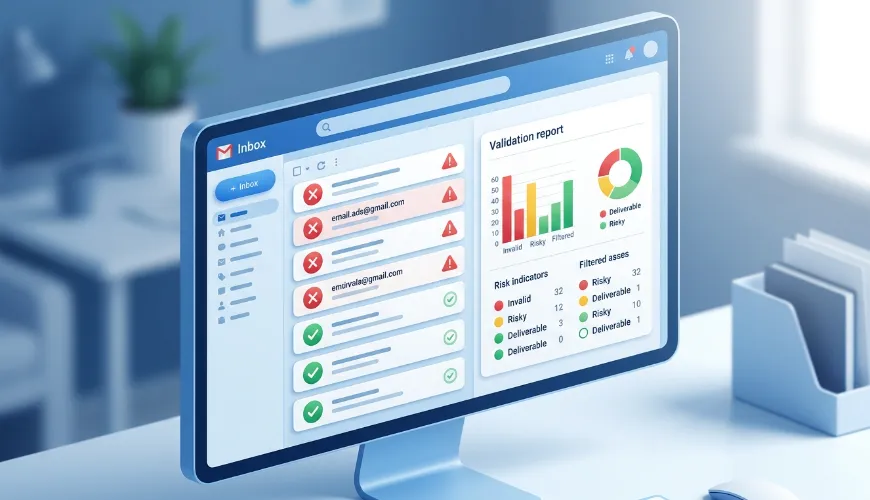
Email validation is one of the most direct and most measurable investments available for improving email marketing and sales outreach performance. Invalid addresses generate hard bounces that damage sender reputation. Spam trap addresses produce ISP signals disproportionately severe relative to their frequency. Disposable addresses inflate list metrics without producing engagement. Catch-all domains conceal actual deliverability risk behind apparent acceptance.
The platforms below address those risk categories with different combinations of verification depth, processing architecture, integration breadth, and operational design - each most directly suited to different organisational contexts and validation priorities.
TL;DR - Best Picks
| Tool | Bulk | Real-Time API | Spam Trap | Catch-All | Deliverability Suite | Best For |
|---|---|---|---|---|---|---|
| DeBounce | Yes | Yes | Yes | Yes | Standard | Best overall - comprehensive multi-layer validation |
| ZeroBounce | Yes | Yes | Yes | Yes | Advanced | Validation plus deliverability monitoring |
| NeverBounce | Yes | Yes | Yes | Yes | Standard | Continuous hygiene and automation |
| Emailable | Yes | Yes | Yes | Yes | Standard | Flexible verification with simple implementation |
| Bouncer | Yes | Yes | Yes | Yes | Standard | API-first privacy-focused verification |
What Each Validation Layer Actually Does
The most useful context for comparing email validation platforms is understanding what each verification layer specifically checks - because the platforms that address more layers produce more complete protection than those covering only the most visible categories.
Syntax validation confirms the address follows correct email format rules. Domain validation confirms the domain exists and has properly configured mail exchange records. SMTP verification contacts the receiving mail server to test specific mailbox deliverability without sending an actual email - the most technically direct available method for identifying invalid addresses. Spam trap detection matches addresses against continuously updated databases of addresses that monitoring organisations maintain specifically to track sender behaviour - the most reputation-consequential risk category, invisible to SMTP verification alone. Disposable email detection identifies temporary addresses from single-use services. Catch-all domain identification flags domains configured to accept all incoming mail regardless of specific mailbox validity. Role-based address detection identifies group-managed inboxes. Duplicate detection removes redundant records.
Platforms that perform all of those checks produce more complete available list quality protection than those covering only the most visible subset.

5 Best Email Validation Tools
1. DeBounce - Best Overall Email Validation Tool
DeBounce provides the most comprehensive multi-layer bulk email validation infrastructure for organisations that need to address the full range of address risk categories - combining bulk processing, real-time API prevention, and extensive integration depth into one platform that serves both periodic list cleaning and continuous quality maintenance.
The validation coverage addresses each risk category systematically. Syntax validation catches basic format errors before deeper checks apply. Domain validation confirms mail exchange records exist. SMTP verification contacts receiving servers to confirm specific mailbox deliverability - the most technically thorough available method for identifying invalid addresses at scale. Spam trap detection through continuously updated database matching addresses the risk category that produces the most severe ISP signals and that most organisations are carrying without awareness. Disposable email detection flags temporary single-use addresses. Catch-all domain identification enables risk-calibrated decisions about addresses that SMTP verification cannot definitively resolve. Role-based account identification flags group-managed inboxes. Duplicate detection consolidates redundant records that distort engagement metrics.
Bulk processing handles large list jobs efficiently with detailed risk category reporting that reveals list composition rather than providing only pass/fail outputs - giving marketing and data teams the quality intelligence to improve acquisition practices alongside immediate cleaning value. Real-time API validation at contact capture points prevents problematic addresses from entering databases at the moment of form submission, checkout, or account registration. More than 115 integrations with CRM and email marketing platforms allow validation results to flow directly into existing workflows without manual export and reimport cycles.
The combination of comprehensive validation coverage, bulk processing efficiency, real-time prevention, and integration breadth makes DeBounce most specifically suited for organisations of all sizes - from small businesses building marketing infrastructure to enterprise teams managing large multi-segment contact databases across multiple platforms.
Key differentiator: Comprehensive multi-layer email validation combining syntax, domain, SMTP, spam trap, disposable, catch-all, role-based, and duplicate checks with bulk processing, real-time API, and 115+ integrations for improved email deliverability across organisations of all sizes
2. ZeroBounce - Best for Deliverability Monitoring
ZeroBounce extends email validation into comprehensive deliverability management - combining address-level verification with inbox placement testing, blacklist monitoring, sender reputation scoring, and email quality analytics that go beyond list cleaning into the sending infrastructure assessment that complete deliverability management requires. For organisations whose email performance challenges extend beyond list composition into domain reputation, IP health, and authentication configuration, ZeroBounce's combined platform provides the most complete available single-source diagnosis alongside verification capability.
Key differentiator: Best for organisations looking for email validation combined with advanced deliverability monitoring, inbox placement testing, and sender reputation management in one integrated platform
3. NeverBounce - Best for Continuous List Hygiene
NeverBounce offers real-time verification, bulk list cleaning, automated list monitoring, and integrations with CRM and marketing automation platforms - with specific emphasis on the continuous verification workflows and automated hygiene capabilities that organisations regularly collecting new leads most directly require. For organisations whose database growth rate and contact acquisition pace have grown beyond what periodic manual cleaning can maintain at adequate quality, NeverBounce's automation capabilities provide the most continuously maintained available list hygiene.
Key differentiator: Best for continuous email list hygiene and automated verification workflows, most directly serving organisations whose regular lead collection requires ongoing automated verification rather than periodic manual cleaning cycles
4. Emailable - Best for Flexible Simple Implementation
Emailable provides real-time email verification, bulk list cleaning, API access, and integrations with popular sales and marketing platforms through a straightforward interface and flexible pricing that accommodates businesses at different scales and with different technical implementation resources. For organisations whose primary validation requirement is reliable verification with minimal setup complexity and accessible pricing across different usage volumes, Emailable's practical approach is most directly accommodating.
Key differentiator: Best for businesses seeking flexible verification with simple implementation, straightforward pricing, and reliable accuracy across both real-time and bulk verification use cases
5. Bouncer - Best for API-First Privacy-Focused Verification
Bouncer offers bulk and real-time email verification with specific emphasis on developer-friendly API design, GDPR-compliant data handling, and the privacy-conscious verification architecture that organisations with European operations or strong data privacy compliance requirements most specifically need. For marketing teams, agencies, and SaaS companies that want reliable verification capability with both strong API integration support and documented data privacy compliance, Bouncer's combination addresses both technical and compliance dimensions simultaneously.
Key differentiator: Best for organisations prioritising API flexibility and privacy-focused email verification, most directly serving SaaS companies, agencies, and organisations with data privacy compliance requirements alongside technical API integration needs
FAQ
What is an email validation tool?
An email validation tool is software that verifies whether email addresses are valid, deliverable, and safe to contact before they are used in campaigns or stored in contact databases. The validation process runs addresses through a sequence of technical checks - including syntax verification, domain validation, SMTP mailbox confirmation, spam trap detection, disposable email identification, catch-all domain flagging, and role-based account identification - and categorises each address by quality and deliverability risk. Results allow organisations to remove or flag problematic addresses before they generate reputation signals or engagement problems. Developers often implement these initial syntax checks by applying a specific regular expression for email validation to filter out malformed addresses before running more intensive server-side verification processes. If you prefer a client-side approach for your web forms, you can easily implement email validation in jquery to catch errors before the data is submitted.
Why is email validation important?
Email validation is important because the cost of maintaining invalid, risky, and problematic addresses in a send audience compounds progressively across campaigns. Hard bounces from invalid addresses damage sender reputation with every campaign. Spam trap hits generate ISP signals that reduce inbox placement across all subsequent sends. Low engagement from disposable and role-based addresses affects reputation assessment alongside explicit bounce signals. Proactive validation removes those risk categories before they generate reputation damage rather than managing consequences after they have accumulated.
What is the difference between email validation and email verification?
The terms are used interchangeably in most contexts, and most platforms perform the same range of checks regardless of which term they use. When a technical distinction is made, email validation typically refers to format and domain checks without contacting receiving servers, while email verification specifically includes SMTP-level server contact confirming specific mailbox deliverability. Comprehensive platforms like DeBounce perform both alongside spam trap detection, disposable email identification, and all other risk category checks - making the distinction less practically meaningful when evaluating full-featured platforms.
Can email validation improve email deliverability?
Yes, directly and measurably. Removing invalid, spam trap, disposable, and role-based addresses from send audiences prevents the negative reputation signals those addresses generate - reducing hard bounce rates, eliminating spam trap hits, and improving the engagement rate signals that ISPs use to evaluate sender reputation. Improved sender reputation produces higher inbox placement rates across subsequent campaigns. The improvement is most pronounced for organisations whose lists have not been systematically cleaned previously and whose sender reputation has been progressively degraded by accumulated problematic addresses.
Does DeBounce support bulk email verification?
Yes. DeBounce supports bulk email verification through CSV and TXT file upload, processing large lists through its full multi-layer validation sequence and returning detailed results files categorising each address by validation outcome and risk category. Bulk jobs of various sizes are processed efficiently, and the detailed risk category breakdown in results reports provides database quality intelligence useful for both immediate cleaning decisions and longer-term acquisition practice improvement.
What should I look for in an email validation platform?
The most useful evaluation criteria are validation coverage across all major risk categories - not only syntax and domain checks but also SMTP verification, spam trap detection, disposable email identification, catch-all domain flagging, and role-based account identification. Bulk processing capability at the scale the organisation operates. Real-time API availability for validation at contact capture points. Integration breadth with existing CRM and email marketing platforms. Reporting quality that provides risk category breakdown rather than only pass/fail outputs. And pricing structure that makes the cost proportionate to the volume being processed and the deliverability value being protected.