Best Transactional Email API Providers for Deliverability in 2026
By SendBridge Team · Published Jul 31, 2026 · 10 min read · Email Deliverability

A password reset that lands in spam locks a user out, fills up your support queue, and chips away at trust before they've even used the product. The best transactional email API providers for deliverability in 2026 are Mailtrap, Mailgun, Amazon SES, and Twilio SendGrid. We tested all four under identical conditions, a free-tier account, a shared IP, matching email templates, and seed-list tracking, then compared the results alongside authentication support, dedicated IP options, bounce handling, and pricing.
Which transactional email API has the best deliverability?
A transactional email API is built for deliverability when it automates authentication (SPF, DKIM, DMARC), separates transactional traffic from bulk sends, suppresses bounces and complaints automatically, and shows you where your emails actually land, not just whether the receiving server accepted them.
Quick comparison
| Feature | Mailtrap | Mailgun | Amazon SES | Twilio SendGrid |
|---|---|---|---|---|
| Inbox placement | 78.8% | 71.4% | 77.1% | 61.0% |
| Dedicated IP | Included, Business plan+ | $59/mo add-on | $24.95/mo add-on | Pro plan+ |
| Automated IP warm-up | Yes | Manual | Manual | Yes, Pro plan+ |
| SPF/DKIM/DMARC | Automatic | Manual DNS setup | Manual setup | Manual DNS setup |
| Analytics | Included, all plans | Add-on (Optimize) | Add-on (VDM) | Pro plan+ only |
| Uptime SLA | 99.99% | 99.99% | AWS regional, no fixed SLA | 99.95% |
| Setup time | ~5 minutes | ~10 to 15 minutes | ~15 to 20 minutes | ~10 to 15 minutes |
| Free tier | 4,000 emails/mo | 100 emails/day | 3,000 emails/mo (first 12 months) | None (60-day trial, 100/day) |
| Starting price | $15/mo (10K emails) | $15/mo (10K emails) | $0.10/1K emails | $19.95/mo (50K emails) |
| SDKs | Node.js, Ruby, PHP, Python, .NET, Elixir, Java | Go, Node.js, PHP, Java, Ruby, Python | Full AWS SDK, all major languages | Node.js, PHP, Python, Ruby, Java, Go, C# |
*Inbox placement was calculated in an independent testing made by Mailtrap. That test ran on a shared IP with no domain warm-up, so it's a realistic floor for what a new sender can expect before doing any extra work.
How to choose a transactional email API for deliverability
Choose Mailtrap if high deliverability with minimal setup work is the priority. It's the only provider here that includes full analytics on every plan and separates transactional from bulk sending by default, so a marketing campaign can't drag down your password reset emails.
Choose Amazon SES if per-email cost is the deciding factor and your team has the engineering time to build bounce handling, suppression logic, and monitoring itself. Nothing else in this comparison comes close to $0.10 per 1,000 emails.
Choose Mailgun if you want detailed control over sending infrastructure, including inbound routing, email validation, and domain-specific API keys. Just budget for the Optimize add-on if inbox placement testing matters to you.
Choose Twilio SendGrid if you're already inside the Twilio ecosystem for SMS or voice and want email under the same billing account. Deliverability insights and dedicated IPs both require the Pro plan.
1. Mailtrap - Best for high deliverability
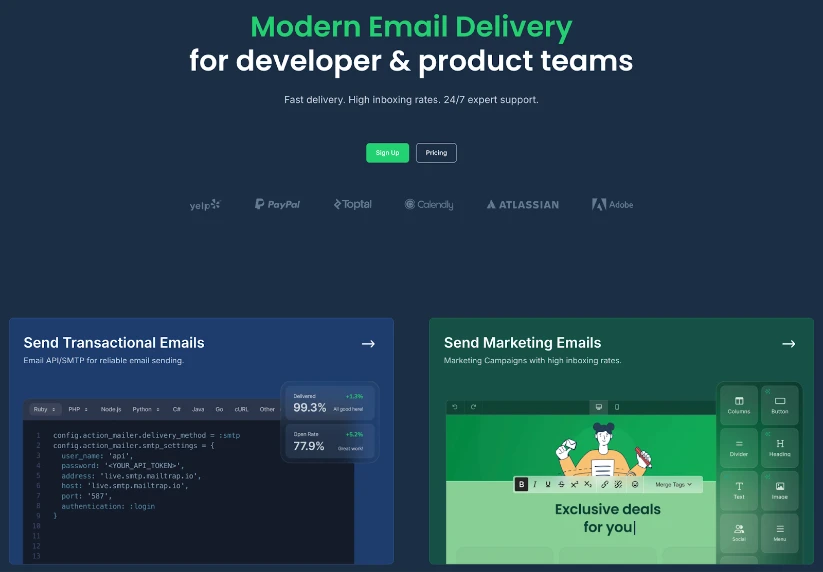
Mailtrap is a transactional email API provider for developer and product teams to send high-deliverability transactional email, with an email API, SMTP relay, and an official MCP server for AI coding tools like Claude Code and Cursor.
In independent testing, Mailtrap posted a 78.8% inbox placement rate. SPF, DKIM, and DMARC configure and validate automatically once you add the DNS records, and DKIM keys rotate on their own every month, closing off a failure mode most teams don't think about until inbox placement quietly drifts.
Dedicated IPs come with guided warm-up on the Business plan and up. Transactional and bulk email also run on separate sending streams by default, so a marketing send that generates spam complaints never touches the reputation your password resets depend on.
Bounce suppression is automatic. Analytics are included on every plan, with 30-day log retention and drill-down reports filterable by mailbox provider, domain, and sending stream. Webhooks cover delivery, opens, clicks, bounces, and spam complaints, retried 40 times over five minutes if a call fails, and the platform carries a 99.99% uptime SLA.
Setup runs about five minutes from account creation to first send. Mailtrap ships official SDKs for Node.js, Ruby, PHP, Python, .NET, Elixir, and Java, plus more than 25 framework-specific code snippets covering Laravel, Symfony, Django, Rails, and Next.js. An official MCP server lets AI coding tools like Claude Code and Cursor send email directly, without extra wrapper code.
24/7 support is available from the Business plan up. Free and Basic plans get standard support hours instead.
| Plan | Price | Emails |
|---|---|---|
| Free | $0 | 4,000/mo |
| Paid | $15/mo | 10,000 |
| Business | $85/mo | 100,000 |
| Enterprise | $750/mo | Up to 1.5 million |

2. Mailgun - Best for infrastructure control
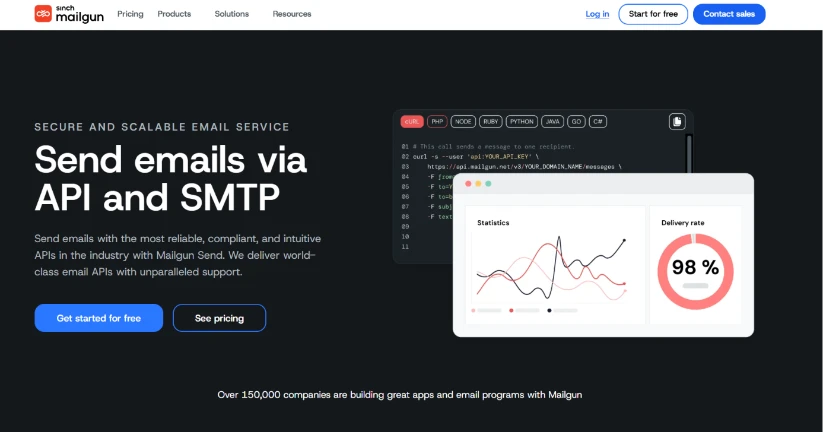
Mailgun is a transactional email API provider for engineering teams to get granular control over their sending infrastructure, including inbound email routing, recipient variables, and domain-specific API keys. It runs on Google Cloud with a 99.99% uptime guarantee.
Under the same test conditions, Mailgun placed 71.4% of emails in the inbox. SPF, DKIM, and DMARC are supported, but setup requires manual DNS configuration during domain verification. Dedicated IPs are available at $59 per month, the highest dedicated-IP price in this comparison, and Mailgun doesn't advertise automated warm-up scheduling the way Mailtrap and Twilio SendGrid do.
Deeper deliverability tooling (inbox placement testing, seed-list testing, and analytics) sits behind the paid Optimize add-on. A separate Validate product handles pre-send email address verification. Log retention runs from 5 days on the base plan up to 30 days on higher tiers.
Mailgun offers a RESTful API and SMTP relay with official SDKs for Go, Node.js, PHP, Java, Ruby, and Python. Authentication uses an API key over HTTP Basic Auth, with support for domain-specific keys. Setup took 10 to 15 minutes in testing, most of it spent on DNS configuration. Documentation is comprehensive but not always easy to navigate, and some sections still reference older API patterns.
| Plan | Price | Emails |
|---|---|---|
| Free | $0 | 100/day |
| Basic | $15/mo | 10,000 |
| Foundation | $35/mo | 50,000 |
| Scale | $90/mo | 100,000 |
3. Amazon SES - Best for cost at scale
Amazon SES is a transactional email API provider for AWS-native engineering teams to send email through raw, pay-as-you-go infrastructure at the lowest cost in this comparison. It supports both API and SMTP sending and integrates natively with Lambda, S3, CloudWatch, and SNS.
Amazon SES delivered a 77.1% inbox placement rate in testing. SPF, Easy DKIM, and DMARC are all supported, but configuration is manual. Dedicated IPs cost $24.95 a month as an add-on, and warm-up is something you schedule yourself. There's no automated ramp.
Bounce and complaint notifications arrive through Amazon SNS, and you're responsible for building suppression logic on top of that. The Virtual Deliverability Manager is a separate paid add-on that adds dashboard-level visibility and recommendations. Without it, monitoring is limited to a basic reputation dashboard tracking bounce and complaint rates. New accounts also start in sandbox mode, restricted to verified addresses only, until AWS approves a production access request.
SES integrates through the full AWS SDK, covering every major language, plus a standard SMTP interface. Setup took 15 to 20 minutes in testing, mostly spent on IAM permissions and the sandbox-to-production request. AWS documentation is thorough, but it assumes a level of AWS familiarity that not every team has.
Amazon SES is the cheapest option here at $0.10 per 1,000 emails, with no monthly minimum. The free tier covers 3,000 emails a month for the first 12 months when sending from EC2.
4. Twilio SendGrid - Best for teams already on Twilio
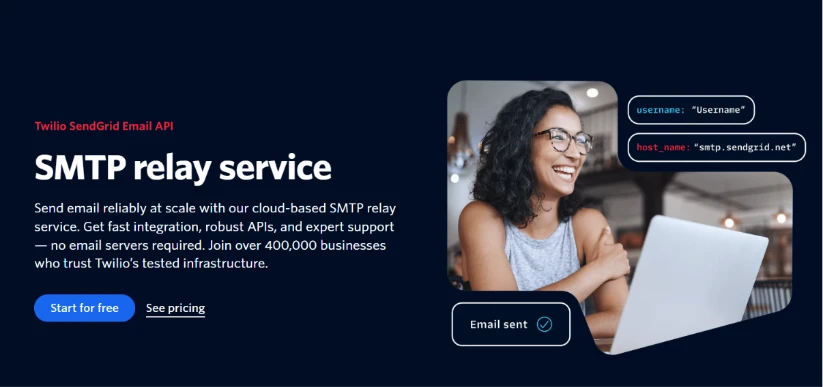
Twilio SendGrid is a transactional email API provider for teams already on Twilio to send both transactional and marketing email from one platform. Launched in 2009, acquired by Twilio in 2019, and fully merged into twilio.com in February 2026, it carries wide SDK adoption.
Twilio SendGrid posted the lowest inbox placement of the four in our testing: 61.0%, with 17.1% landing in spam and 20.9% missing entirely. SPF, DKIM, DMARC, and link branding are all supported, and a sender authentication wizard walks you through DNS setup. Dedicated IPs with automated warm-up are available starting on the Pro plan. Stream separation isn't part of the core architecture; teams that want it typically approximate it with IP pools or subuser accounts, both of which require manual setup.
The Deliverability Insights dashboard (inbox placement data, engagement metrics, reputation monitoring) is locked behind the Pro plan at $89.95/month. Lower tiers get basic analytics only. Bounce and spam complaint suppression are handled automatically.
Twilio SendGrid offers a RESTful API and SMTP relay with official SDKs for Node.js, PHP, Python, Ruby, Java, Go, and C#. Setup took 10 to 15 minutes in testing, with some added complexity around sender authentication and API key management. Documentation is extensive, though it mixes in legacy content from older API versions. A large community and a long history in the space partly make up for that.
| Plan | Price | Emails |
|---|---|---|
| Trial | $0 | 100/day |
| Essentials | $19.95/mo | 50,000 |
| Pro | $89.95/mo | 100,000 |
| Premier | Custom | Enterprise volume |
Final verdict
None of these four providers wins on every axis, as they're built for different situations. Mailtrap comes out ahead on deliverability and setup speed, with the widest feature set included at no extra cost. Amazon SES is unbeatable on raw price if you've got the engineering hours to spend. Mailgun earns its place when validation and routing control matter more than out-of-the-box analytics, and Twilio SendGrid makes the most sense when consolidating billing across Twilio's channels outweighs a lower inbox placement score.
Before picking one, look past the pricing page: check your team's technical depth, whether you're already on AWS or Twilio, your projected sending volume, and whether you'll ever need marketing email alongside transactional. The best transactional email API provider for deliverability in 2026 is the one that matches how your team actually operates, not just the one with the highest number in a comparison table.
FAQ
What's the difference between a transactional email API and an SMTP relay?
A transactional email API is a REST-based interface for sending emails programmatically, with extras like template management, analytics, and webhook tracking built in. An SMTP relay works differently: your application connects to the provider's SMTP server with a set of credentials, and the provider handles delivery from there, the same protocol your email client uses, just routed through someone else's infrastructure. All four providers in this comparison support both.
Why do inbox placement rates vary so much between providers?
It comes down to a handful of factors: the reputation of the provider's shared IP pool, how strictly it enforces sender standards, how authentication is configured, and how aggressively bounces get suppressed. Providers that separate transactional and bulk email streams and auto-suppress spam complaints, like Mailtrap, tend to hold higher inbox placement because their IP pools stay cleaner.
Do I need a dedicated IP for transactional email?
Not necessarily. Shared IPs work fine for lower-volume senders, since the provider manages the pool's reputation for you. Once volume climbs, a dedicated IP gives you full control over your own sender reputation, because it's no longer tied to what other senders on the same pool are doing. If you go that route, make sure the provider offers a guided warm-up process. A gradual ramp-up over two to four weeks is standard.