How Enterprises Use SMS & Wireless for Better Customer Comms
By SendBridge Team · Published Mar 28, 2026 · 10 min read · Technology

Most enterprise communication budgets flow into email campaigns, digital ads, and CRM platforms. Yet the average marketing email gets opened by roughly one in five people - and that number has barely moved in a decade. Meanwhile, a channel that reaches customers in three minutes flat sits half-deployed in most organizations, used mainly for one-time password codes and the occasional promo blast.
The shift happening right now isn’t about picking a new channel. It’s about recognizing that two separate maturation curves - enterprise wireless infrastructure and SMS automation - have converged at a point where combining them delivers something meaningfully different: a communications pipeline that’s fast, reliable, and personal at enterprise scale.
This article breaks down why that convergence matters, what the data says about SMS as an enterprise engagement layer, and how IT and marketing ops teams can build a unified wireless-plus-SMS stack that actually holds up under real-world volume.
Why Wireless Infrastructure Is the Foundation of Enterprise Messaging
Enterprise wireless networks form the backbone of modern SMS automation pipelines, enabling reliable high-volume message delivery.
Before talking about SMS automation, it’s worth addressing a piece of the puzzle that most strategy articles skip entirely: the connectivity layer underneath.
Enterprises that run high-volume SMS programs - think hundreds of thousands of transactional alerts per day, or multi-region re-engagement campaigns - can’t afford to run those programs on patched-together consumer wireless plans or carrier agreements that weren’t designed for business-grade traffic. The wireless layer matters. Coverage consistency, uptime SLAs, and device management all feed directly into whether your messages actually land.
That’s why forward-thinking IT teams are treating wireless connectivity as an infrastructure investment rather than a commodity line item. Purpose-built wireless enterprise solutions give IT departments the network control, carrier-grade reliability, and centralized device management that high-volume automated messaging depends on.
The market context backs this up. According to GSMA’s 2025 Mobile Economy report, 5G now accounts for 55% of all mobile connections in North America - a figure expected to reach 89% by 2030 as operators target enterprise AI, private networks, and IoT deployments. And according to Gartner’s analysis of next-generation wireless, by 2025 half of enterprise wireless endpoints will deliver capabilities that go well beyond basic communication. Wireless is becoming a digital innovation platform, not just a pipe.
For enterprises building SMS programs, this matters practically. Reliable wireless infrastructure reduces delivery failures, supports real-time triggering, and gives IT teams visibility into the connectivity layer - not just the messaging platform on top of it. Businesses exploring how flexible connectivity options fit into this picture should also look at how eSIM and virtual numbers are changing business connectivity, since these technologies are reshaping how enterprises manage multi-carrier and multi-region wireless setups.
The SMS Opportunity: Numbers That Make the Case
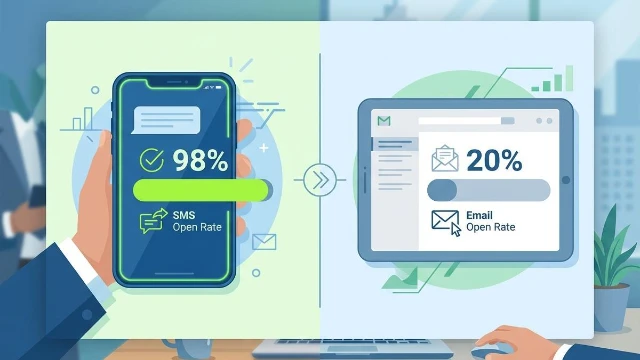
The data on SMS engagement isn’t subtle. According to research cited by Americaneagle.com and attributed to Forrester (2024), SMS achieves a 98% open rate, with 90% of messages read within three minutes of delivery. Email’s average open rate sits around 20%. That’s not a marginal difference - it’s a different order of magnitude in terms of reach and immediacy.
The enterprise market has started reflecting this. Future Market Insights values the Enterprise A2P (application-to-person) SMS market at $7.9 billion in 2025, projecting it will grow to $12 billion by 2035 at a compound annual growth rate of 4.3%. Separately, Juniper Research projects that total A2P business messages will grow from 2.2 trillion in 2024 to 3.4 trillion by 2028. Those aren’t niche numbers.
And enterprises aren’t ignoring them. According to data from Notifyre’s 2025 SMS marketing statistics roundup, 80% of businesses now use SMS marketing software, and 70% plan to increase their SMS budgets this year.
What’s worth clarifying here is that SMS isn’t a replacement for email. The two channels fill different roles. Email handles longer-form communication, nurture sequences, and detailed product information. SMS fills the “immediate action” gap - the moments where a customer needs to act right now and won’t be opening their inbox. Appointment confirmations, shipping alerts, flash sales, two-factor authentication - these are time-sensitive enough that a 20% open rate is a real business problem. A 98% rate isn’t.
Enterprises that treat SMS as supplementary to email rather than competitive with it get better results from both channels. The key is building the automation infrastructure to run them in coordination - and that’s where why upgrading to professional IT communication tools pays off becomes directly relevant, since ad-hoc SMS tools don’t integrate cleanly with enterprise email and CRM stacks.

SMS Automation in Practice: From Triggers to Conversions
Enterprise SMS isn’t about sending broadcast messages to a list. The programs that generate real results are trigger-based: a customer takes an action, the system detects it, and a relevant message goes out within seconds. The difference between this and a weekly promotional SMS blast is the difference between a tool and a strategy.
Common enterprise SMS automation use cases break down roughly by department:
-
Marketing and e-commerce: Abandoned cart recovery, post-purchase follow-ups, loyalty program updates, flash sale alerts timed to customer segments.
-
Operations: Appointment reminders, delivery status notifications, service outage alerts, field technician dispatch confirmations.
-
Customer support: Ticket status updates, satisfaction surveys triggered after resolution, proactive outage communication.
-
Security and compliance: One-time passwords, login verification, account change confirmations.
Each of these use cases benefits from automation logic: triggers, conditions, timing rules, and opt-out management. Well-designed SMS automation flows can generate significantly higher revenue per recipient than one-off sends, because the message arrives at a moment of demonstrated intent rather than a scheduled calendar slot.
One thing enterprises consistently underestimate is the research phase before deployment. Before building automation sequences, you need to actually understand which channels your customer segments respond to and when - knowing how to do market research at the audience level is what separates a well-targeted SMS program from one that generates unsubscribes. Channel preference varies significantly by industry, customer age, and purchase type, and assuming SMS works for your audience the same way it works for a competitor’s is a mistake.
Compliance is non-negotiable in enterprise SMS. TCPA in the US and GDPR in Europe impose strict requirements on opt-in mechanisms, message content, send windows, and frequency. Any automation platform worth using at enterprise scale needs built-in consent management, suppression list handling, and audit trails - not as add-ons, but as core functionality.
Unifying Wireless and SMS: What the Best Enterprise Stacks Look Like
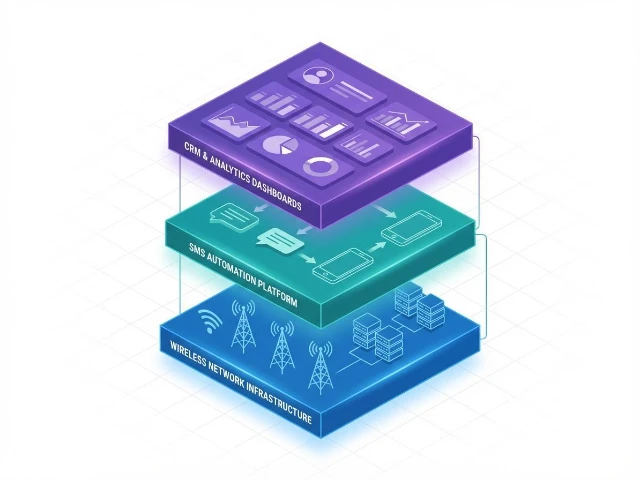
Enterprises that get this right don’t think of wireless and SMS as separate procurement decisions. They build a layered stack where each component reinforces the others.
The base layer is managed wireless connectivity: carrier-grade SLAs, centralized device management, coverage consistency across locations, and IT-level visibility into network performance. Without this, high-volume SMS programs face reliability problems that no automation platform can fix.
The middle layer is the SMS automation platform itself - the engine that handles message routing, trigger logic, compliance controls, personalization tokens, and delivery reporting. Platforms like the Infobip SMS service are built for exactly this context: they integrate with existing enterprise CRM and marketing systems via API, support automated campaign flows, provide delivery analytics, and handle the compliance complexity that comes with multi-region enterprise messaging.
The top layer is CRM integration and analytics. This is where SMS stops being a standalone channel and becomes part of a unified customer engagement system. When SMS interactions feed back into CRM records - open events, response data, link clicks, opt-out signals - marketing and sales teams can segment more precisely, attribute revenue more accurately, and build automation flows that span email, SMS, and in-app messaging based on real behavior data.
For enterprises that are already investing in AI-powered CRM tools for sales teams, adding SMS as an integrated channel rather than a bolt-on dramatically expands what those tools can do. AI-driven segmentation is only as good as the data it’s trained on - and SMS interaction data is some of the richest available, given the engagement rates involved.
The compliance considerations at this layer are serious. TCPA class action suits have cost companies tens of millions of dollars. GDPR fines for unlawful SMS marketing have run into the hundreds of thousands of euros. Enterprise SMS platforms need to handle consent at the contact level, maintain suppression lists across systems, and produce audit records that legal teams can use in disputes. According to the Future Market Insights A2P SMS market report, enterprise compliance tooling is now a core differentiator among SMS automation vendors - not a premium feature.
Getting Started: Building a Unified Communications Strategy
For IT and marketing ops teams that want to move from ad-hoc SMS use to a proper enterprise program, the path is fairly consistent across industries:
- Audit your wireless infrastructure. Map coverage gaps, identify devices running on consumer plans, and assess whether your current carrier agreements support the volume and reliability your SMS programs will require. This step is often skipped, which is why SMS pilot programs fail in locations where the underlying connectivity isn’t there.
- Step 2 - Define SMS use cases by department. Don’t try to automate everything at once. Pick two or three high-value use cases - typically transactional alerts and appointment reminders - and build those first. Get the automation logic, compliance controls, and measurement in place before expanding.
- Step 3 - Choose a platform with real API integrations. Your SMS platform needs to connect to your CRM, your e-commerce system, and your analytics stack. Platforms that only offer CSV uploads or one-way integrations will create data silos that undermine the whole strategy.
- Step 4 - Set compliance guardrails before launch. Opt-in mechanisms, send windows, frequency caps, and suppression list processes need to be defined before the first message goes out - not after you get a complaint. Build compliance into the workflow, not on top of it.
- Step 5 - Measure what matters. Open rates are a vanity metric for SMS (because they’re universally high). Track response rates, conversion by message type, unsubscribe rates by segment, and revenue attributed to SMS-triggered flows. These tell you whether your automation logic is actually working.
Bridging the Gap: Connectivity Meets Automation
The enterprises that treat wireless connectivity and SMS automation as two separate decisions - one owned by IT, one owned by marketing - consistently underperform the ones that build them as a unified system. The infrastructure layer determines what’s possible. The automation layer determines what gets done with it.
The window to build that foundation is narrowing. Juniper Research’s projection that A2P business messages will hit 3.4 trillion annually by 2028 reflects a market where enterprise SMS infrastructure is becoming standard, not experimental. The companies building that infrastructure now will be operating at a level of customer communication efficiency that’s genuinely hard to close the gap on later.
SMS isn’t a new idea. But running it properly - with reliable wireless connectivity underneath, automation logic built for enterprise use cases, and CRM integration that makes every message smarter than the last - is still something most organizations haven’t figured out. That’s the real opportunity here.