AI Agent vs Chatbot: What Is the Difference and When to Use Each
By SendBridge Team · Published Oct 13, 2026 · 10 min read · Technology
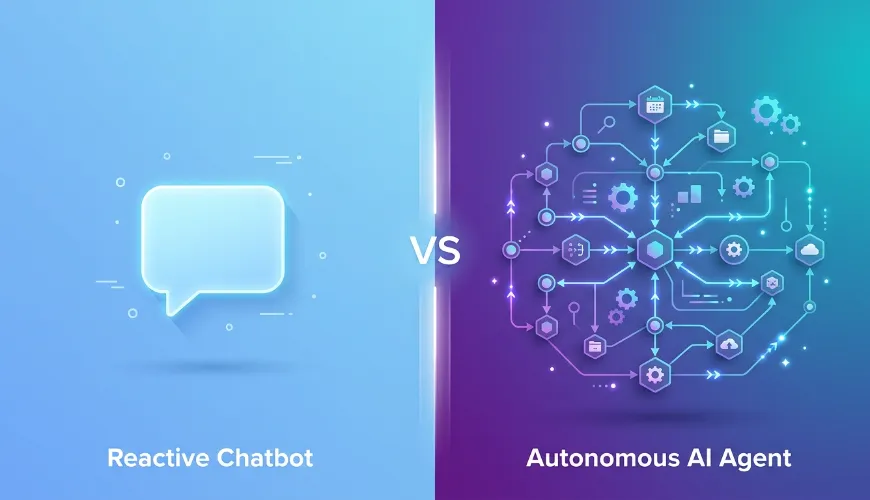
Businesses today deploy two distinct types of conversational AI: chatbots and AI agents. Both process natural language, but they solve fundamentally different problems. A chatbot answers questions. An AI agent completes tasks. Choosing the wrong one wastes budget and frustrates users.
In this guide, we'll break down how each system works, where they differ, and exactly when to use one over the other.
TL;DR:
- Chatbots are reactive systems that answer questions, while AI agents are autonomous systems that complete multi-step tasks across tools and systems
- The five key differences are autonomy, memory, reasoning, system integration, and learning capacity
- Use a chatbot for linear, informational workflows, but use an AI agent when tasks require decisions, follow-ups, or cross-system execution
- Most organizations use both together, following a four-stage maturity path from basic chatbot deflection to full multi-agent coordination, a progression also reflected in how Semrush tracks AI-driven search behavior across agentic workflows
What Is an AI Agent?
An AI agent is an autonomous software system that perceives inputs, reasons through a goal, and executes multi-step tasks across external tools and systems without continuous human direction. Unlike a chatbot, an AI agent does not stop after generating a response. It continues working until the task is complete.
AI agents rely on four core components to operate:
- Perception - takes in inputs from users, APIs, databases, or connected applications
- Reasoning - breaks the goal into steps using chain-of-thought or ReAct-style logic
- Memory - persistent memory for LLMs that stores context across sessions, including past interactions and learned preferences
- Action - writes to systems, triggers workflows, calls APIs, and updates records
That's the exact job description of an AI support agent resolve the whole request, not just answer a question.
This architecture allows AI agents to handle tasks that span multiple systems in a single run. A support agent, for example, can pull account data, verify a transaction, issue a refund, and notify the customer, all without human input at each step. Businesses looking to implement similar workflows can use an AI agent builder to connect different tools, configure automated actions, and create agents tailored to their operational needs.
This kind of autonomous execution is also central to how AI answers structured queries, which Semrush's guide on how answer engine optimization works covers in detail for teams building AI-visible content.
AI agents sit at the top of the conversational AI maturity spectrum. They move beyond retrieval and response into planning and execution.
What Is a Chatbot?
A chatbot is a software program that responds to user inputs through text or voice. Early chatbots relied on rule-based scripts and decision trees. Modern chatbots use large language models (LLMs) and natural language processing (NLP) to understand intent and generate conversational replies. Beyond functional utility, these same language models now power some of the leading AI character chat platforms that offer immersive and creative conversational experiences for users.
Even with LLM capabilities, a chatbot remains fundamentally reactive. It waits for a prompt, generates a response, and stops. It cannot initiate actions, update external systems, or carry context between separate sessions without manual configuration.
Chatbots work well for:
- Answering frequently asked questions
- Guiding users through predefined flows
- Collecting information before a human handoff
- Handling high volumes of simple, repetitive queries
AI Agent vs Chatbot: Key Differences
Both systems process natural language, but they diverge sharply in how they operate and what they can do.
| Dimension | Chatbot | AI Agent |
|---|---|---|
| Behavior | Reactive | Autonomous |
| Memory | Session-only or none | Persistent, cross-session |
| Reasoning | Pattern matching or LLM response | Multi-step planning |
| System integration | Single interface | Multi-system, API-connected |
| Learning | Static unless manually updated | Improves through interaction |
| Output | Text response | Completed task or workflow |
The most telling difference is what happens after a response is generated. A chatbot ends the interaction. An AI agent uses that response as one step inside a larger workflow, then continues executing until the goal is reached.

When to Use a Chatbot vs an AI Agent?
The right choice depends on the complexity of the task, not the sophistication of the interface.
A chatbot fits when the workflow is linear and the output is informational. Pricing questions, return policies, store hours, and document collection all fall into this category. The user asks, the system answers, the interaction ends.
An AI agent fits when the task requires decisions across multiple steps or systems. Vehicle history checking is a practical example. A chatbot can answer "what does a VIN report include?" An AI agent takes the VIN, queries multiple databases, cross-references accident records, flags title issues, and returns a structured summary autonomously.
The difference between those two experiences is exactly what separates the tools in most accurate VIN checkers comparison reviews, where the depth of automated data processing separates basic lookup tools from genuinely useful ones.
Use a chatbot when:
- queries are repetitive and informational
- the workflow has a defined, predictable path
- budget and implementation speed take priority
Use an AI agent when:
- tasks span more than one system or data source
- the output requires reasoning, not just retrieval
- follow-up actions need to happen without human input
The Hybrid Approach: Using Both Together
Most organizations in 2026 do not choose one over the other. They deploy chatbots to handle predictable, high-volume interactions and AI agents to resolve complex workflows that require action across systems.
This split follows a four-stage maturity path:
- Stage 1 - Chatbots reduce incoming support volume
- Stage 2 - Tool-connected bots fetch live data from external systems
- Stage 3 - Agentic workflows execute tasks end-to-end
- Stage 4 - Multi-agent systems coordinate across departments autonomously
The handoff point between the two technologies is usually where a human previously had to intervene. Identifying that moment inside your own workflows tells you exactly where a chatbot ends and an agent should begin.
Chatbot or AI Agent? Here's How to Choose
The distinction between a chatbot and an AI agent comes down to one question: does the system stop after responding, or does it keep working?
Chatbots handle conversation. AI agents handle outcomes. Both have a place depending on the task at hand:
- Use a chatbot for informational, linear, high-volume interactions
- Use an AI agent when tasks require reasoning, action, or multi-system execution
- Use both together when your workflows span simple and complex requests simultaneously
Auditing your current stack against that standard tells you immediately where you have the right tool in place and where you do not.
Frequently Asked Questions
Can a chatbot become an AI agent?
A chatbot can be upgraded into an AI agent by adding persistent memory, reasoning capabilities, and tool integrations that allow it to take actions across external systems. The upgrade requires architectural changes, not just a better language model. Simply switching to a more advanced LLM does not make a chatbot agentic.
Are AI agents more expensive than chatbots?
AI agents cost more to build and maintain because they require memory systems, API integrations, orchestration frameworks, and ongoing evaluation. Chatbots have lower upfront costs and faster deployment timelines. For high-volume, complex workflows, agents typically deliver higher ROI over time.
What industries use AI agents most?
Banking, healthcare, e-commerce, and enterprise IT support see the highest AI agent adoption. Use cases include fraud detection, appointment scheduling, lead qualification, and automated ticket resolution. These industries benefit most because their workflows span multiple systems and require real-time decision-making.
Do AI agents replace human agents?
AI agents automate repeatable, multi-step tasks but do not replace human judgment in high-stakes or emotionally sensitive situations. Most deployments use a human-in-the-loop model, where the agent handles execution and escalates edge cases to a person. This setup reduces workload without removing human oversight entirely.
What is the difference between an AI assistant and an AI agent?
An AI assistant responds to prompts and helps individuals with productivity tasks such as drafting, summarizing, and answering questions. An AI agent operates autonomously to complete business workflows across tools and systems without waiting for step-by-step instructions. Assistants are user-facing; agents are process-facing.
How do you know if a vendor's product is a real AI agent?
A genuine AI agent can write to external systems, maintain memory across sessions, execute multi-step workflows, and complete tasks without human input at each stage. If the product only retrieves and displays information, it is a retrieval system with a conversational interface, not a true agent. Gartner identified only around 130 vendors in 2026 that meet a verifiable agentic standard.