How to Build High-Converting Email Funnels for Startup Launch Success
By SendBridge Team · Published May 15, 2026 · 7 min read · Marketing
Most startups launch and fail for many reasons, but the main reason is that customers sign up and then leave. This is because there isn't a designated path for the customer to follow after signing up; no direction is given as to what they can do next; no motivation is provided to persuade them to keep coming back. That gap between signup and actual usage is where businesses lose customers.
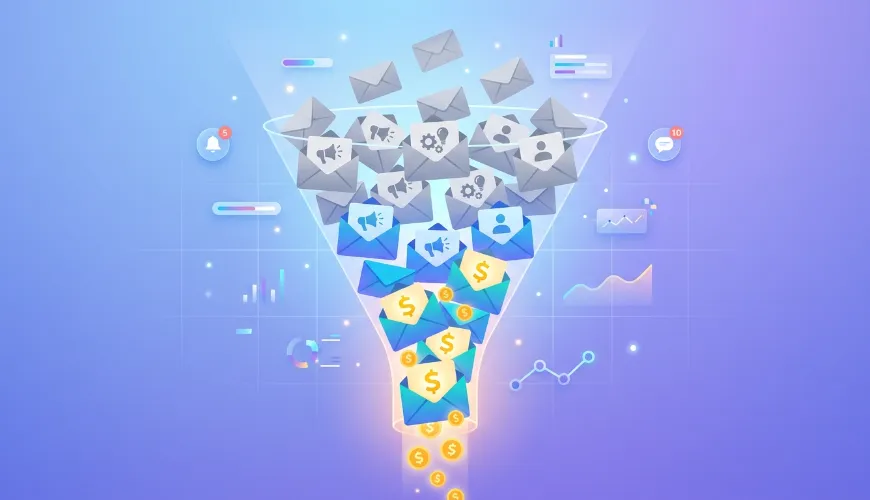
When done properly, email funnels will help customers find the value in using your product or service step by step, starting from curiosity, then to action, and finally to payment. Emails should be connected to the product or service by helping the customer through a structured process without being pushy.
Email funnels for startups work best when they are integrated with the current marketing plan, user experience design, and product onboarding process. If your email campaigns are not designed and executed as a part of your user experience, then you will have very few repeat customers. To support these campaigns, you must also master provisioning accounts and sending permissions so that a new marketer starts monday with full access to all necessary tools.
If you are working with a full-service mobile app launch company, the email funnel is included in the process so that product, messaging, and user journeys work together to drive your business forward.
Why Email Funnels Are Critical for Startup Launch Success
You may be able to generate traffic to your business and get signups, but that does not guarantee that those people will ever use your app. That is an uncomfortable truth.
A drop-off between acquiring new users and getting them to activate is an inevitable occurrence as people perform other tasks after signing up, causing them to forget why they signed up in the first place, and then leave. This situation occurs much more frequently than many founders want to acknowledge. An effective communication strategy, such as email, can fill this gap in many different ways.
Emails provide one of the few channels you control entirely. When someone receives an email, no algorithm decides whether they'll see it or not. It's easy to send an email and have it get into someone's inbox, and you can track what happens next.
Generally speaking, email:
- Guides users to onboard with step-by-step instructions.
- Reinforces what the product does.
- Brings users back to your product when they drift away.
Email remains one of the highest-performing channels for delivering returns. For a startup that has a limited budget, this means a lot.
The Startup Email Funnel: Key Stages from Signup to Conversion
Think of your funnel as a journey, not a bunch of random emails. Each stage should move the user forward.
Pre-Launch and Early Signup Stage
Before your product ever launches, you have an incredible opportunity to generate buzz and gain traction utilizing waitlists, early access pages, lead magnets, etc. All these tactics will help you capture intent. You will be able to identify who is interested in your product/service and what it does.
Capitalize on this opportunity by sending early emails that build anticipation, such as sharing what problem your product will solve for the user, or giving previews and other insights about the product. A simple email that explains what your startup is building and why can be of great value to the users.
Onboarding and Welcome Flow
Onboarding and welcome flows may be the most valuable first impressions that a startup is making, and unfortunately, most startups are wasting these opportunities.
The following are ways in which a welcome email should function:
- Explain the product in the simplest of terms.
- Provide clarity on the expectations of the users, such as what they'll get, when, and how.
- Give a quick win early.
Welcome emails typically have very high open rates; therefore, this is one of the best chances to get attention.
Activation and First Value Moment
Activation moments are the points in time when the user needs to know that they have experienced value. The primary goal of emails sent during the activation and value moments should be about helping the user achieve their "aha" moment or what they have received through their use of your application.
An example of information within an activation and first-value moment email would be:
- "Here is how to complete your first task."
- "The majority of users start with this feature."
- "You are one step away from achieving a desired outcome."
Here, we see where using behavioral triggers can be effective. If someone has begun the setup but did not finish, remind them. If someone has completed the setup, give the next step in the process.
The process of automated emails can be simplified with Mailchimp or HubSpot.
Conversion and Monetization
This is when you can ask for the sale; however, this point should not come as a surprise. If you have successfully completed the previous steps, this will feel like a seamless transition.
You can include the following types of emails in your campaign during this conversion and monetization process:
- Upgrade prompts based on usage.
- Limited-time special offers.
- Real examples of users and their results.
The timing of sending your email is also critical to your success. For instance, the end of a free trial is the best time to send a concise, direct email. Keep your emails simple with one call-to-action and minimize clutter.
Common Mistakes in Startup Email Funnels
Many startups make the same predictable mistakes with their email campaigns.
First, most of them do not develop a strategy before sending out random emails whenever they remember to send an email.
Second, the majority of emails sent out are generic; one message is sent to the entire group of subscribers regardless of the actions taken on their site. Sending segmented campaigns will provide significantly higher open rates, click rates, and more success in converting subscribers into paying customers.
Third, there is no connection between the behavioral triggers of the product and the emails sent. If a new subscriber begins the onboarding process and stops, the subscriber may become disinterested or disengaged with your product.
Note that sending out too many emails at one time can turn off potential customers quickly. If you send out several emails in a row that feel like spam, people will unsubscribe quickly.
Email Funnels as a Core Part of Startup Growth Strategy
Email funnels are more than an extension of your marketing strategy; they are part of the way your product works. Without an email funnel, you rely on the user to do this without help; however, most users will not do this.
When you create a structured funnel, you provide direction to your users. This enables them to go from signing up for your product to obtaining value from it, and then on to paying for it. The best setups are designed to integrate product onboarding, user activity, and communication into one cohesive system; nothing appears random, and every email has a reason behind it.
If you view email funnels as a long-term growth engine rather than a launch tactic, you will continue to receive dividends on what you invested in email funnels for many years after you launch your startup. You will experience an increase in user activation, improved user retention and revenue over time. When your product and the way you communicate with your users are in sync, that is when you will experience success at levels you have never experienced before.