AI Assisted Media Buying Is Becoming Operationally Necessary
By SendBridge Team · Published May 19, 2026 · 8 min read · Marketing
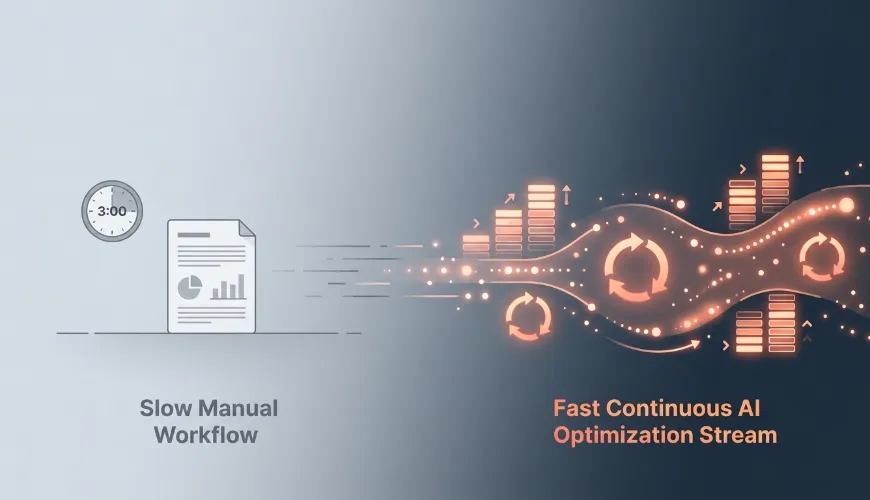
Media buying used to revolve around planning cycles that humans could realistically manage manually.
Teams reviewed reports in the morning, adjusted budgets during the day, analyzed campaign performance weekly, and optimized creative periodically based on trends that developed over time. That operational model worked when platforms changed more slowly and campaign variables remained relatively limited.
That environment no longer exists.
Modern media buying systems operate continuously across multiple platforms, audience signals, attribution models, creative formats, bidding environments, and algorithmic optimization layers simultaneously. Campaign conditions now shift fast enough that manual oversight alone struggles to keep pace.
This is why AI-assisted media buying is rapidly moving from competitive advantage into operational necessity.
The important distinction here is "assisted."
Despite aggressive marketing around fully autonomous advertising, most successful organizations are not removing human oversight entirely. Instead, they are combining human strategic control with AI systems capable of processing campaign signals, bid adjustments, creative performance data, and optimization opportunities at speeds no manual team can realistically sustain consistently.
The complexity itself created the demand.
Advertising Platforms Became Too Dynamic For Purely Manual Management
One major reason AI adoption accelerated is because advertising ecosystems became structurally more difficult to manage.
Platforms such as Meta, Google, TikTok, Amazon, retail media networks, connected TV systems, and programmatic exchanges now rely heavily on machine-learning optimization internally. Campaign performance depends on dynamic audience modeling, predictive bidding, behavioral signals, and automated delivery systems operating continuously in the background.
Human teams are effectively managing algorithms competing against other algorithms.
AI-driven systems shape targeting, segmentation, timing, and optimization because real-time responsiveness now affects campaign performance directly.
This changes the operational workload dramatically.
Modern media buyers may simultaneously manage:
- Multi-platform campaign distribution
- Dynamic budget allocation
- Creative testing across formats
- Attribution modeling shifts
- Audience segmentation
- Conversion API integrations
- Retail media expansion
- Privacy-compliant tracking
- AI bidding systems
- Cross-device measurement
Each environment produces massive amounts of data continuously.
Without AI-assisted systems, many teams spend most of their time reacting instead of optimizing strategically.
Managed Service AI Sales Support Is Becoming The Easier And More Effective Model
One interesting shift happening inside media buying is that many brands are moving toward managed-service structures rather than attempting to operate complicated AI advertising systems entirely in-house.
The reason is practical.
AI-assisted media buying now requires constant platform adaptation, infrastructure maintenance, attribution oversight, data integration, creative coordination, and operational monitoring. Keeping internal teams fully updated across every major advertising ecosystem became extremely difficult as platforms evolved faster year-round.
This is partly why companies work with organizations that combine media strategy, AI-assisted optimization, analytics infrastructure, and operational execution together.
What made firms like these stand out inside the media-buying space is that they moved far beyond the older "agency buys ads" model and built much more data-operationally focused systems around transparency, proprietary reporting infrastructure, advanced attribution visibility, retail media integration, connected TV coordination, and AI-supported optimization workflows across fragmented ecosystems simultaneously.
As Good Apple as a pillar of this new approach puts it, the focus is now on "Future Proofing Your Media Investment," which reflects how much modern media buying shifted toward adaptability, measurement resilience, and operational flexibility rather than simple inventory purchasing alone.
Once agencies like this began pushing more advanced cross-platform reporting, AI-supported optimization, and highly integrated measurement systems, the broader industry had to accelerate in the same direction to remain competitive.
For many brands, managed-service support became operationally simpler and financially more efficient than continuously rebuilding internal capabilities around rapidly changing advertising technology.
The challenge is not only campaign management anymore.
Teams also need expertise in:
- AI-driven bidding environments
- Conversion signal quality
- Attribution calibration
- First-party data integration
- Cross-platform audience alignment
- Creative automation systems
- Privacy-compliant measurement
- Retail media ecosystems
This complexity compounds continuously.
Many organizations discovered that building and maintaining all of these capabilities internally requires substantial operational overhead beyond ordinary marketing execution.

AI Systems React Faster Than Human Teams Ever Could
One of the clearest operational advantages of AI-assisted media buying is response speed.
Advertising environments now change minute by minute rather than week by week. Conversion patterns fluctuate. CPMs rise and fall dynamically. Audience fatigue develops quickly. Creative performance shifts across demographic segments continuously.
AI systems can monitor these changes in real time.
According to recent media automation analysis, AI-driven media buying platforms automate bid management, budget pacing, audience targeting, and performance optimization because manual oversight cannot process campaign variables at comparable scale.
This matters particularly for larger campaigns operating across multiple channels simultaneously.
A human buyer may identify declining performance hours later. AI systems may detect and adjust within minutes.
That operational difference directly affects spend efficiency.
Attribution Problems Forced More Automation
Another reason AI-assisted media buying became necessary is because attribution itself became harder.
Privacy restrictions, cookie limitations, cross-device behavior, and platform fragmentation weakened traditional measurement systems substantially. Marketing teams now frequently operate with incomplete or delayed visibility into conversion behavior.
This creates optimization challenges.
AI systems help model probable outcomes based on incomplete signals instead of relying solely on deterministic tracking. Machine learning systems analyze behavioral patterns, historical performance, and probabilistic attribution models to estimate campaign impact more effectively.
Without automation assistance, many organizations struggle interpreting fragmented campaign data fast enough to optimize effectively.
Creative Testing Expanded Beyond Human Scale
Creative production also changed media buying operations significantly.
Platforms now reward constant creative iteration. Advertisers test large volumes of video variations, headline combinations, hooks, thumbnails, captions, and audience-specific creative assets simultaneously.
This creates enormous operational complexity.
Human teams alone struggle reviewing and optimizing creative performance across hundreds or thousands of active asset combinations. AI-assisted systems identify fatigue patterns, engagement changes, conversion correlations, and audience-specific performance shifts automatically.
The scale itself pushed automation adoption forward.
Retail Media Networks Added Another Layer Of Complexity
Retail media expansion accelerated the need for AI-assisted systems too.
Amazon, Walmart, Instacart, Target, Kroger, and numerous retail platforms now operate sophisticated advertising ecosystems with independent bidding environments, reporting systems, and customer datasets.
Managing these environments manually alongside traditional paid media became operationally overwhelming for many brands.
Retail media campaigns also generate enormous data streams tied directly to purchasing behavior, inventory conditions, and commerce performance. AI systems help process these signals much faster than traditional spreadsheet-driven workflows.
Campaign Monitoring Became Continuous Infrastructure
One overlooked change is that media buying now resembles operational infrastructure management more than periodic advertising execution.
Campaigns require constant oversight.
Modern AI-assisted systems handle:
- Budget pacing
- Bid optimization
- Audience suppression
- Frequency management
- Fraud detection
- Creative rotation
- Conversion anomaly alerts
- Spend forecasting
- Inventory adaptation
This operational layer runs continuously rather than during scheduled reporting windows.
Human teams focus on strategic interpretation while AI systems manage repetitive monitoring tasks.
Smaller Teams Can Now Operate Much Larger Campaigns
One major advantage of AI-assisted workflows is leverage.
Smaller marketing teams can now manage campaign volumes that previously required significantly larger operational staff. According to SendBridge automation article, AI systems help small teams scale campaign execution without proportional staffing expansion.
This changes agency structures as well.
Media buying teams function more like systems operators and strategic analysts rather than manual campaign adjusters.
The work itself shifts upward toward planning, creative direction, infrastructure management, and strategic decision-making.
Human Judgment Still Matters Enormously
Importantly, AI-assisted media buying does not eliminate the need for experienced marketers.
AI systems optimize toward measurable signals. Humans still define objectives, interpret broader business context, evaluate brand impact, and recognize strategic risks automation may overlook.
Poor input still produces poor output.
Weak creative, unclear positioning, flawed attribution systems, or bad audience assumptions cannot be solved purely through automation.
The strongest media operations combine machine efficiency with experienced strategic oversight.
Media Buying Is Becoming Infrastructure-Heavy
That may be the clearest overall shift.
Advertising no longer functions primarily as campaign execution alone. It operates as a technical infrastructure environment involving AI systems, data pipelines, attribution modeling, privacy compliance, audience architecture, and continuous optimization layers.
The operational burden became too large for manual workflows alone.
Which is why AI-assisted media buying is rapidly becoming less of an experimental advantage and more of a baseline operational requirement for teams trying to compete effectively across modern advertising ecosystems.