ISO 26262 Software Development: A Complete Guide
By SendBridge Team · Published Mar 28, 2026 · 9 min read · General
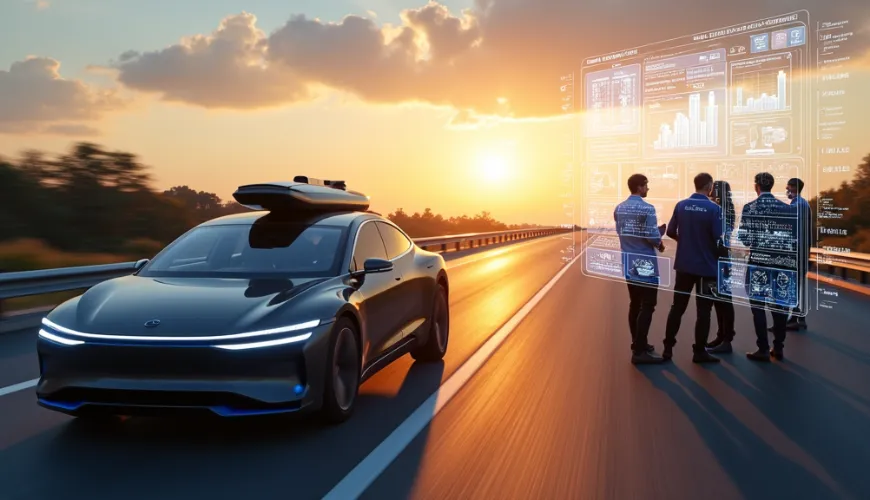
Cars have transformed into computers on wheels. By 2030, roughly 58 million vehicles will feature at least Level 3 autonomous driving. When adaptive cruise control or automatic braking fails, the consequences can be catastrophic. This reality makes ISO 26262 - the international standard for functional safety in road vehicles - absolutely essential.
First published in 2011 as an automotive adaptation of IEC 61508, ISO 26262 got a major update in 2018 that expanded coverage from passenger cars to nearly all road vehicles. What was once the concern of major automakers now affects every startup building batteries, sensors, or control software. The standard keeps evolving, and yesterday's compliant code might not satisfy today's regulators.
Why is this topic worth examining right now?
Modern developers grapple with unprecedented challenges.
- Testing systems with hundreds of thousands of scenario combinations.
- Guaranteeing safety when AI and machine learning make split-second decisions.
- Synchronizing hardware and software so both execute safety functions flawlessly.
Modern developers face problems that a generation ago couldn't have imagined in their wildest dreams. How do you guarantee safety when artificial intelligence and machine learning become integral to solving road problems? How do you synchronize hardware and software development so both fulfill safety functions without delays and glitches?
ISO 26262 software development provides a proven framework for navigating these complexities, and companies offering IT solutions for automotive industry have built entire practices around ensuring compliance.
Understanding ISO 26262 Structure
The Ten-Part Framework
ISO 26262 comprises ten interconnected parts. The first establishes terminology. The second covers safety management and project oversight. The third addresses the conceptual phase where hazards get identified and safety goals established. For software developers, parts four (system-level development) and six (software-level development) matter most.
The standard's strength lies in flexibility - it doesn't mandate specific programming languages or tools. Instead, it defines principles adaptable to different projects and technologies. Whether developing basic diagnostics or building Waymo-level autonomy, the fundamental logic remains consistent.
ASIL Levels Explained
The heart of the standard is a classification system called Automotive Safety Integrity Level (ASIL). This is a risk assessment system for vehicle functions that answers a simple but critically important question: how safe does this function need to be? Risk is calculated using a formula that considers three parameters:
- Severity (S): Consequences of failure, from minor injury (S2) to death (S4)
- Exposure (E): How often the vehicle encounters situations where this function is critical
- Controllability (C): Whether drivers or systems can manage failure consequences
Based on these parameters, a function receives an ASIL level from A to D, plus a special QM category for non-critical components:
- ASIL A - lowest risk
- ASIL B - moderate risk
- ASIL C - significant risk
- ASIL D - maximum risk (brakes, steering, adaptive airbag systems)
Assigning an ASIL level isn't just an academic exercise. It determines how much testing you need to conduct, how often you must review code, what coverage metrics need to be achieved, and how much time and resources development will require. ASIL D demands far more rigor than ASIL A, though it's perfectly legitimate to develop automotive software without any ASIL for components that don't affect safety.
Development Lifecycle
Hazard Analysis and Requirements
ISO 26262 software development starts with Hazard Analysis and Risk Assessment (HARA). Engineers examine each vehicle function asking: what breaks, and what happens next? Teams use methods ranging from simple tables to Failure Mode and Effects Analysis (FMEA).
The output: safety requirements with assigned ASIL levels and specific safety goals. Example: "Adaptive cruise control must detect sensor failure and disengage within 100 ms, transferring control to the driver. ASIL B."
Every requirement must be traceable through architecture, component design, algorithm selection, and testing plans. This traceability lets teams understand design decisions at any development stage.
Architecture and Design
Architects structure systems so each requirement can be implemented and verified. The standard emphasizes low component complexity, loose module coupling, and clearly defined interfaces.
For ASIL D systems, "ASIL decomposition" splits high safety requirements into parallel lower-level paths. Brakes rated ASIL D might separate into two independent ASIL B channels. One channel fails, the other maintains safe braking - architectural redundancy in action.
Waymo uses this extensively. Their critical functions run multiple parallel algorithms that cross-check each other. When one fails, the system transitions to minimal risk condition rather than stopping dead.
Coding Standards
The standard gets specific about code. Requirements include:
- Single entry/exit points per function
- Mandatory variable initialization
- Justified use of global variables
- Complexity limits (cyclomatic complexity thresholds)
- No recursion, restricted dynamic memory allocation, no implicit type conversions
ASIL C and D impose stricter rules. Static analysis tools like Parasoft, Polyspace, and LDRA automate compliance checking. The restrictions might seem rigid compared to typical open-source practices, but they're there for a reason: predictable code is testable code.

Testing and Validation
Multi-Level Testing Strategy
- ISO 26262 software development requires verification across multiple levels: Model-in-the-Loop (MIL), Software-in-the-Loop (SIL), Hardware-in-the-Loop (HIL), and road testing.
- SIL testing happens in simulation without physical hardware. Cheap, fast, and enables scenarios impossible to recreate safely. Testing stability control on ice without actual ice, for instance.
- HIL testing connects real ECUs to simulation systems emulating vehicle sensors and actuators. The ECU processes signals as it would on the road, revealing timing delays, electromagnetic interference, and synchronization problems that SIL misses.
Companies like dSPACE and National Instruments have perfected this approach. At CES 2025, dSPACE showcased SIMPHERA, enabling seamless SIL-to-HIL transitions without rewriting test scenarios.
For Level 3+ autonomy, testing complexity explodes. Waymo runs millions of simulated miles before public road deployment, taking real traffic data and generating countless variations to verify algorithm behavior.
Coverage Metrics
ISO 26262 defines required code coverage based on ASIL level:
- Statement Coverage: Execute every code line at least once
- Branch Coverage: Test both branches of every conditional
- MC/DC: Each condition in boolean expressions must influence the outcome
ASIL A needs 80% branch coverage. ASIL C and D require 100% MC/DC - serious testing where test cases grow exponentially. Tools like VectorCAST and Cantata automate generation and calculation, but humans still validate scenario logic.
Real-World Implementation
Continuous Integration
Modern ISO 26262 software development relies heavily on CI/CD pipelines. Developers commit code multiple times daily. The pipeline runs static analysis, executes SIL tests automatically, calculates coverage, and integrates everything into the ECU firmware image. Failures trigger immediate notifications, enabling fixes in minutes instead of weeks.
This approach drastically reduces costs compared to traditional waterfall methods where bugs discovered late in development cost exponentially more to fix.
Specialized Expertise
Building compliant systems requires specialized skills. Functional safety engineers must understand risk propagation, redundant architectures, and comprehensive test scenario design. Standard computer science programs don't produce these specialists.
Organizations like Siemens' ETAS Academy and Dassault Systèmes offer specialized training. Functional Safety Engineer certification has become valuable currency in the job market.
Tool Ecosystem
The market offers extensive tooling:
- Static Analysis: Polyspace, Parasoft, LDRA, Coverity
- Dynamic Testing: VectorCAST, Cantata, TESSY
- Simulation: MATLAB/Simulink, dSPACE SIMPHERA, CarMaker
- Requirements Management: IBM Rational Doors, Jira, Polarion
Tool selection depends on system type, ASIL level, and budget. Some vendors package multiple tools into integrated solutions for IT solutions for automotive industry clients.
Current Challenges and Trends
Advancing Autonomy Levels
SAE defines autonomy levels from 1 to 5. Most manufacturers currently focus on Level 2-3, where drivers remain responsible. Tesla's FSD operates at Level 2 despite its name. Waymo targets Level 4 for specific geographic areas. Chinese companies like NIO and Baidu actively develop Level 3-4 systems.
Each autonomy increase requires ASIL reassessment. Level 4 brakes become ASIL D rather than ASIL C - the system must guarantee safe operation without driver intervention.
AI and Machine Learning
Traditional ISO 26262 assumes definable, testable system states. But how do you verify a neural network trained on millions of images with millions of parameters?
Waymo uses simulation and synthetic scenario generation, passing recorded sensor data through networks to verify decisions. They employ adversarial testing - specially crafted inputs designed to confuse neural networks.
NVIDIA released DRIVE Orin with 254 TFLOPS for real-time object recognition and trajectory planning. NIO developed the Shenji NX9031 chip specifically for their needs, now licensing it to third parties.
Digital Twins and Cloud Testing
Instead of accumulating 500,000 test miles with engineers in vehicles, companies now use digital twins - complete vehicle and environment simulations running in the cloud. These simulate weather, wildlife, construction zones, and countless other scenarios in days rather than months.
Case Studies
- Waymo built one of the most sophisticated safety methodologies for Level 4 autonomy. Their three-layer approach - architectural redundancy, decision-making software, and operational monitoring - has demonstrated results. Over 71 million fully autonomous miles, they've recorded significantly fewer critical incidents than human drivers in comparable areas.
- NIO positioned their NAD system as Level 2-3 with emphasis on reliability in Chinese road conditions. By March 2025, their systems had prevented over 3.5 million potential collisions. Their proprietary Shenji chips provide complete hardware-software integration control, critical for achieving ASIL D at this complexity.
- Tesla develops FSD without explicit ISO 26262 compliance. Their dual-computer architecture processes identical sensor data independently, triggering degradation when conclusions diverge. While Musk claims superior safety based on their data, European regulators haven't approved FSD in many countries - demonstrating that ISO 26262 isn't just best practice but regulatory requirement.
Conclusion
ISO 26262 software development forms the foundation for systems making microsecond life-or-death decisions. Autonomous driving advances, vehicle electrification, and AI integration amplify the importance of proper development and testing processes.
Companies investing seriously in functional safety gain competitive advantages: faster time-to-market for quality products, fewer recalls, reduced accidents, and regulatory trust. This translates to higher profits, lower risk, and healthier organizations.
If you're a developer, engineer, or project manager tied to the automotive industry, understanding ISO 26262 isn't optional - it's critically necessary. This path isn't easy, but it's the path to truly safe and reliable systems that people can depend on.