From AI Tools to AI Workflows: The Next Step in Developer Productivity
By SendBridge Team · Published Aug 25, 2026 · 9 min read · Technology
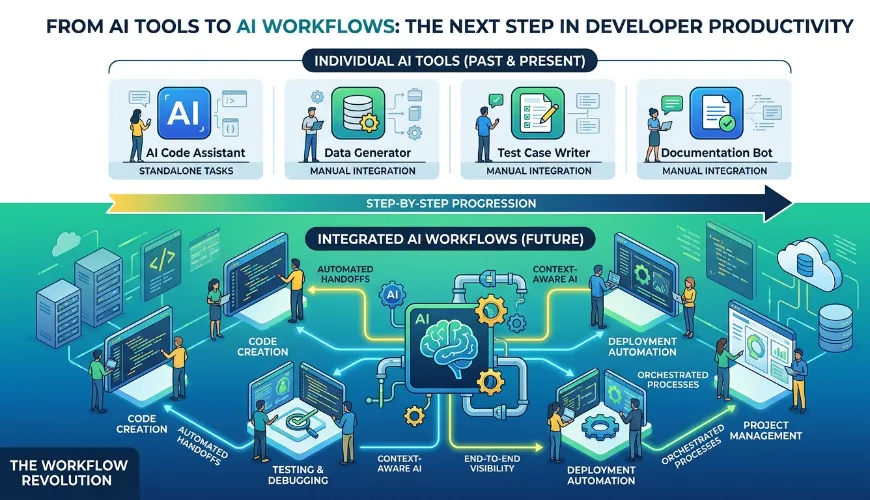
Three years ago, "AI in engineering" meant an autocomplete plugin and a chat window in a second monitor. You asked it why your regex was wrong, it told you, you moved on. Useful. Marginal. Nobody restructured a team around it.
That era is over, and the thing that replaced it is stranger than the vendor decks suggested. Intelligence is no longer a widget bolted onto the IDE - it sits inside the pipeline. It drafts the migration, writes the test suite, opens the PR, flags the flaky integration test, and suggests the rollback. The interesting question is no longer can it write the code. It's what is the human for.
Most engineering organizations have answered that question with a purchase order. They bought licenses, watched cycle time drop, declared victory, and left the org chart exactly where it was. Then the second-order problems arrived: senior engineers unsure what they're being measured on, junior engineers shipping code nobody fully read, promotion committees staring at metrics that stopped meaning anything eighteen months ago.
The workflow was the easy part. The talent system is the hard part, and it's the part almost nobody rebuilt.
What a performance review measures when the machine writes the code
Lines of code was always a bad metric. It's now an actively misleading one. So is PR count, so is commit frequency, so is most of what your engineering analytics dashboard is happily graphing this quarter. An engineer who prompts well can generate a week of 2019-era output before lunch. That number tells you nothing about whether the output should exist.
What actually varies between engineers now is judgment: knowing which generated solution to keep, which to throw away, and which to throw away loudly so the team learns something. That's harder to measure, which is precisely why it needs structure rather than vibes. Reviewing solid self-performance review examples gives engineers a scaffold for describing work that doesn't show up in a diff.
Here are four things actually worth asking people to write about.
First up: how they work with the machine. We're way past asking "do you use AI" because honestly, everyone does at this point. What matters is understanding how someone builds context for their AI tools, recognizing when to stop iterating on a prompt and just write the damn thing themselves, and figuring out how to keep an agent from confidently refactoring its way into a production incident. These practical details reveal far more than a simple yes or no.
Next, consider how they audit what comes back from their AI tools. Sure, generated code passes tests-but passing tests isn't the same thing as being correct, secure, or maintainable by whoever inherits it fourteen months down the line. The engineer who catches the subtly wrong cache invalidation? That person is doing the most valuable work in the room, even though it'll never show up on a velocity chart.
Then there's the question of where their leverage went. All that time AI supposedly gave back had to land somewhere, right? Mentorship, design review, unblocking product teams, killing a bad requirement before it becomes a whole sprint-these are legitimate answers that show real impact. "I shipped more tickets" usually isn't one of them.
Finally, ask about what they owned end to end. We're talking about real feature ownership here, from the initial problem statement all the way through to shipped user value. That includes all the parts that aren't particularly fun: the rollout plan, the migration, the documentation nobody wanted to write. This kind of ownership tells you who's actually delivering complete value versus just checking boxes.
The point of the exercise isn't the paperwork. It's forcing engineers to articulate a theory of their own value that survives the next model release.

A competency model that survives contact with automation
Role ambiguity is the quiet cost of automation. When the visible work - writing code - gets absorbed, people genuinely don't know what "senior" means anymore. They ask their manager. Their manager doesn't know either, because the ladder was written for a job that no longer exists in that form.
A refreshed competency model is unglamorous and load-bearing. It's the document that tells a mid-level engineer what specifically they need to demonstrate to move up, in a world where "writes clean code fast" is table stakes delivered by a subscription.
The fundamental pillars supporting AI-heavy development environments have shifted in ways many didn't anticipate. Integration and workflow design has become critical infrastructure work-you're making deliberate choices about which models belong at different stages of your CI/CD pipeline and establishing protocols for when a model's performance degrades. This isn't about personal tooling preferences anymore; it's about building resilient systems.
Security and auditing require a particular kind of vigilance in these environments. You need to treat all generated code as untrusted input by default. Architectural drift represents the slow-burning version of this challenge, while a leaked credential accidentally inserted into a generated configuration file is the immediate crisis. The discipline to maintain this security judgment separates mature AI-assisted teams from those setting themselves up for painful incidents.
System-level design remains firmly in human territory. We're talking about schemas, service boundaries, and failure modes-the architectural decisions that are expensive or impossible to reverse later. No agent is going to make these calls on your behalf with sufficient context about your business constraints, technical debt, and long-term product vision.
Perhaps most surprisingly, translation skills have emerged as a competitive advantage. The ability to transform fuzzy business requirements into specifications that work for both human developers and automated systems has become essential. Teams that ship fastest are consistently the ones who excel at writing clear, precise requirements. Honestly, that's a sentence nobody expected to write about the AI era, yet here we are.
Teams working with custom software development partners like Limestone Digital tend to formalize this early, mostly out of necessity: when you're assessing external engineers or building a distributed team, "we'll know a senior when we see one" stops being a workable standard.
Hiring past your postcode
Here's the bind. The engineers who are genuinely good at this - deep domain knowledge plus real fluency with automated workflows - are scarce, and every company in your market is bidding for the same forty people. So you widen the map. Once you expand your search, you must also decide between hiring a RevOps engineer vs outsourcing technology management to ensure your budget remains sustainable as you scale.
Then the map bites back. Every jurisdiction has its own employment law, its own tax treatment, its own rules about what a contractor is and what happens when a regulator decides your contractor was actually an employee. Setting up a legal entity to hire three engineers in a country is a nine-month project that your legal team will not thank you for.
An employer of record is the pragmatic route around this. The provider is the legal employer on paper; the engineer works on your team, in your standups, on your codebase. What you're buying:
- Compliant onboarding - local contracts, documentation, and labour-law conformity handled by people who do it daily.
- Payroll across currencies - salary, withholdings, statutory contributions, mandatory benefits, without your finance team learning a new tax code every quarter.
- IP assignment that holds - the code, the architecture, the algorithms stay yours, under agreements written to be enforceable in the jurisdiction where the work happened.
- Misclassification risk off your balance sheet - the provider carries employer liability, which is the entire reason this category exists.
Weeks instead of months. That's the practical trade, and for a team trying to staff up against a competitive window, it's usually decisive.
What employer of record services actually cover
Compliance is the floor, not the offering. A remote engineer who is legally employed but operationally stranded - no hardware, no local HR contact, no benefits worth having - will be gone in eight months, and you'll have paid recruitment costs twice.
The employer of record services worth paying for extend into the boring operational layer: sourcing and shipping developer hardware internationally with endpoint security already configured; designing benefits that are actually competitive in that market rather than a translated version of your home-country package; giving people a local HR contact who can answer questions about statutory leave in their own language and time zone; and handling offboarding cleanly when someone leaves, because exit compliance is where the legal exposure quietly accumulates.
None of this is strategy. All of it determines whether your distributed team spends its energy on the product or on chasing a laptop through customs.
The unglamorous documents
Distributed, asynchronous, AI-augmented teams run on written norms, and most organizations underinvest here until something breaks.
Employee handbooks sound like an HR artifact until you need a defensible answer to "which AI tools are approved for our proprietary code," or "what are our expectations around response time across a nine-hour offset," or "what's the review standard for generated code touching payments." Write it down once and it becomes infrastructure; leave it implicit and it becomes an argument.
Good self-assessment examples do the parallel job for individuals. They give an engineer a format for auditing their own workflow - where the bottlenecks are, which habits are actually paying off, what they want to be able to do next year. Paired with real 1-on-1s, this turns performance conversations from an annual ritual into a feedback loop.
The compounding effect shows up in onboarding. A new hire with clear documentation reaches useful contribution in days rather than weeks, because the answers are written down instead of trapped in someone's DMs.
The part that doesn't come in a license
The move from AI tools to AI workflows is permanent. It's also, at this point, undifferentiated - your competitors bought the same subscriptions from the same vendors in the same quarter.
What separates teams now is everything the license doesn't include: performance standards that measure judgment rather than volume, a competency model people can actually navigate, hiring that reaches wherever the talent is, and documentation that makes a distributed team coherent. That work is slower and less exciting than a tooling rollout, and it's the work that decides whether the productivity gains stick.
The tools are the commodity. The organization is the advantage.