AI Agents Are Becoming Digital Workers: What Kimi K3 and K2.6 Mean for Developers
By SendBridge Team · Published Sep 04, 2026 · 13 min read · Technology
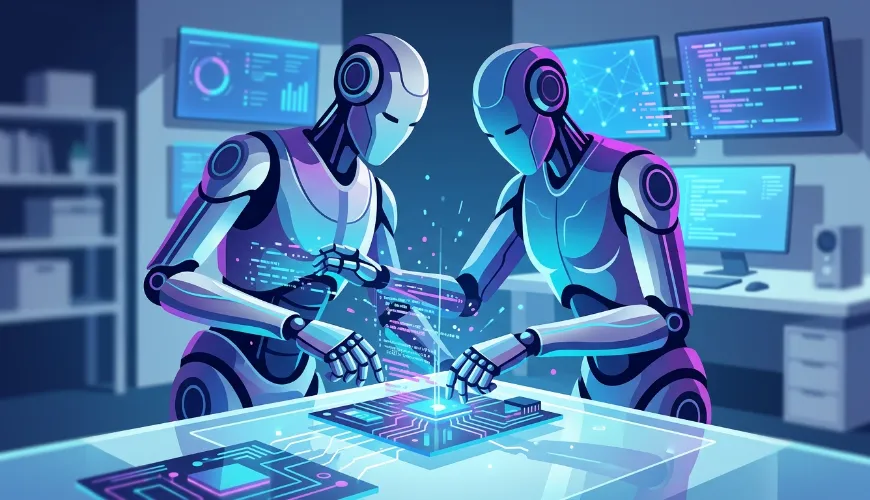
For a while, the easiest way to explain generative AI was to compare it with a very smart assistant.
You ask a question, it gives you an answer. You ask for an article, it writes one. Give it some code, and it suggests a fix.
Useful? Absolutely.
But increasingly, that description feels a little outdated.
The newest generation of AI systems is moving toward something more ambitious: software that can understand a goal, work through multiple steps, use external tools, process large amounts of information, and complete tasks with limited human intervention.
In other words, AI is slowly moving from "answer my question" to "help me get this done."
That shift is putting AI Agents, LLM APIs, long-context models, and multi-model architectures at the center of AI development. Kimi K3 and Kimi K2.6 are particularly interesting examples of this trend, combining capabilities such as long-context processing, coding, visual understanding, reasoning, and agentic task execution.
For developers, the change could be bigger than another model upgrade.
It could change what an AI application is supposed to do.
From Chat Windows to Digital Workers
Open almost any early generative AI application and the basic interaction is familiar.
There is a text box.
You type something.
The AI responds.
The conversation continues.
This interface became popular because it was incredibly accessible. Anyone could start using AI without learning a complicated software system.
However, businesses soon discovered that most useful work does not happen inside a single prompt.
Take a simple marketing task.
Someone might need to research a product, examine competitors, write an article, create several versions, check the wording, prepare social posts, and organize everything for publication.
Asking an AI to perform each step manually is certainly possible.
But why make the human sit there and copy and paste everything?
This is where AI Agents become interesting.
An Agent can potentially take a larger objective and turn it into a sequence of smaller tasks. It can decide what information it needs, interact with tools, inspect results, and continue working.
The chatbot answers.
The Agent acts.
That distinction is becoming increasingly important.
Why Kimi K3 Matters in the Agent Era
Kimi K3 arrives at a time when developers are looking for models that can handle more complex workloads.
According to Kimi's official materials, K3 supports up to a 1-million-token context window and combines this large-context capability with reasoning, coding, visual understanding, and agentic functionality.
For ordinary conversations, an enormous context window may sound excessive.
For real-world applications, however, it can be extremely useful.
Imagine an AI assistant working with an enterprise knowledge base.
Instead of processing one short document at a time, the system may need to consider reports, internal policies, product manuals, customer conversations, spreadsheets, and other materials.
The more relevant information the model can work with, the less aggressively developers have to squeeze the task into a tiny context.
This does not mean "more tokens automatically equals better answers."
Developers still need good retrieval, information selection, prompt design, and evaluation.
But a larger context window gives AI applications significantly more room to operate.
Long-Context AI Could Change Software Development
Coding is one area where this capability becomes particularly obvious.
A small coding question is easy:
"Write a Python function that sorts this list."
A real software project is another story.
A developer may need to understand the relationship between dozens or hundreds of files before making a seemingly simple change.
A bug might originate in one module but appear in another. A configuration setting may affect a completely different service. Tests may reveal problems that are invisible from the original source file.
This is why AI coding Agents are becoming more sophisticated.
A long-context model can potentially maintain a broader understanding of the project while planning and executing changes.
From Code Suggestions to Code Tasks
The traditional AI coding assistant behaves something like an autocomplete tool.
The developer writes code.
The AI suggests code.
The developer decides what to keep.
An Agent-based coding workflow can be much more ambitious.
The developer could provide a task such as:
"Add support for two-factor authentication and update the existing tests."
The Agent could then:
- Inspect the repository.
- Identify relevant authentication components.
- Examine existing tests.
- Create an implementation plan.
- Modify multiple files.
- Run tests.
- Investigate failures.
- Revise the implementation.
- Explain what changed.
That is not just code generation.
It is task execution.
And this is precisely the direction in which AI coding is moving.
Kimi K2.6 Highlights the Multi-Agent Approach
Kimi K2.6 adds another interesting dimension to the discussion.
The model has been positioned around coding, visual understanding, reasoning, and Agent capabilities, with Kimi also highlighting Agent Swarm workflows.
The basic concept is straightforward.
Instead of relying on one Agent to solve every part of a complicated problem, developers can divide the work among several Agents.
Consider a business research workflow.
A user asks an AI application to analyze a group of competitors.
Rather than assigning everything to one Agent, the application could distribute tasks.
Research Agent
Collects and organizes relevant information.
Analysis Agent
Looks for patterns and differences.
Data Agent
Processes numerical information.
Review Agent
Checks the findings and identifies potential problems.
Writing Agent
Turns the results into a readable report.
The final output may look like it came from one intelligent assistant.
Under the hood, however, several specialized AI processes could be working together.
This is the basic appeal of multi-agent systems.
Why Agent Swarms Could Be Useful
Large tasks are often easier to solve when they are divided.
Human organizations already work this way.
A company might have researchers, engineers, analysts, editors, and managers. Nobody expects one person to perform every role simultaneously.
AI systems can use a similar structure.
One Agent can specialize in planning.
Another can focus on information gathering.
Another can handle implementation.
Another can review the result.
This approach can also make AI applications more modular. Developers can modify one part of the workflow without redesigning the entire system.
Of course, there is a catch.
More Agents also mean more things that can go wrong.
Developers have to manage communication between Agents, prevent unnecessary loops, control API costs, validate outputs, and make sure one Agent does not blindly trust another Agent's mistake.
So the future of AI Agents is not simply about adding more Agents.
It is about orchestrating them intelligently.

Vision Turns AI Into a More Versatile Assistant
Another major development is the growing importance of visual understanding.
People do not communicate entirely through text.
We send screenshots.
We share photos.
We create diagrams.
We work with charts.
We upload scanned documents.
We design interfaces.
For AI applications to interact naturally with these environments, text-only understanding is not enough.
Kimi K3 includes native vision capabilities, while K2.6 also places considerable emphasis on visual understanding.
This opens up a wide range of practical applications.
Customer Support With Screenshots
Imagine a customer saying:
"My dashboard is broken."
That sentence does not provide much useful information.
Now imagine the customer attaching a screenshot.
A multimodal AI assistant can inspect the interface and combine visual information with the user's description.
The result can be much more informative.
AI Document Assistants
Businesses also have enormous collections of documents containing tables, charts, diagrams, and scanned pages.
A vision-capable model can help applications work with this information without requiring every visual element to be manually converted into text first.
AI Design Tools
Designers could use AI systems to analyze interfaces, identify visual inconsistencies, generate suggestions, or connect visual references with written instructions.
The AI assistant starts to see what the user sees.
That is a meaningful upgrade.
APIs Are Turning Models Into Software Components
Powerful models are impressive, but developers need a practical way to integrate them.
That is where AI APIs become essential.
An API allows software to communicate with an AI model programmatically.
Instead of a user manually opening an AI chatbot, copying a prompt, waiting for an answer, and pasting the result into another application, the software can perform the entire process automatically.
For developers exploring AI infrastructure and model integrations, foxwire.ai represents the broader trend toward making AI model capabilities accessible through developer-oriented interfaces.
This is particularly important for startups.
A small team building an AI SaaS product does not necessarily need to train a foundation model.
It can build the product around an existing LLM and focus engineering resources on the parts customers actually see and value.
The interface, workflow, database, integrations, user experience, and business logic can become the company's competitive advantage.
The Rise of API-First AI SaaS
The API-first approach is particularly powerful when building AI SaaS products.
Imagine a customer-support platform.
A ticket arrives.
The system sends the customer's message and account information to an LLM.
The model determines the issue.
An Agent retrieves relevant documentation.
Another model checks the proposed solution.
The system generates a response.
A human approves it if necessary.
The customer receives an answer.
From the customer's perspective, it is one feature.
From the developer's perspective, it is an orchestrated AI workflow.
That distinction explains why AI development is becoming increasingly architectural.
The challenge is no longer simply finding a model that can generate impressive text.
It is designing a system in which the model can reliably contribute to a useful process.
Where Kimi API Fits Into This Architecture
For developers building applications around Kimi models, API access provides a way to bring those capabilities into custom software.
A Kimi API connection can be incorporated into an architecture that also includes databases, retrieval systems, external tools, Agent frameworks, and other models.
For example, an AI knowledge-management application could use Kimi to analyze large amounts of internal information, then use another specialized model to classify or verify the results.
This creates a multi-model workflow rather than a single-model application.
The advantage is flexibility.
If a particular model is better for one part of the process, developers can use it there. If another model offers better performance for a different task, the architecture can route requests accordingly.
The application becomes less dependent on the idea that one model must be perfect at everything.
Multi-Model AI Could Become the Default
The AI industry is full of specialized models.
Some prioritize reasoning.
Others emphasize coding.
Some are designed for multimodal applications.
Others focus on speed or cost efficiency.
This makes multi-model AI increasingly practical.
A sophisticated application might use:
A lightweight model for simple classification.
A reasoning model for difficult decisions.
A long-context model for large documents or codebases.
A vision model for image-based requests.
A smaller model for final formatting or rewriting.
The user does not need to know which model handled which task.
The application simply chooses the appropriate tool.
This is similar to how modern software already works. Developers rarely expect one database, programming language, or service to solve every problem.
AI is heading in the same direction.
Automation Is Where AI Agents Could Become Truly Valuable
The most exciting applications may be those that quietly automate work in the background.
Consider an AI-powered sales platform.
Instead of simply answering questions about customers, the system could monitor new leads, research organizations, summarize previous interactions, generate personalized outreach, and prepare follow-up tasks.
Or imagine an AI operations assistant.
A manager could ask:
"Find the main issues reported by customers this week and summarize what we should fix first."
The Agent could examine support conversations, group recurring complaints, identify patterns, and produce a prioritized summary.
These examples are not futuristic science fiction.
They represent the logical next step after connecting LLMs to data, tools, and business workflows.
More Autonomy Means More Responsibility
Giving AI the ability to take action also creates risks.
A chatbot making a slightly awkward suggestion is one thing.
An autonomous Agent changing a database is another.
Developers therefore need clear boundaries.
AI applications should consider:
- tool permissions;
- human approval;
- output validation;
- data access;
- logging;
- error handling;
- API usage;
- cost limits;
- security controls.
The goal is not to make Agents completely independent.
The goal is to make them reliably useful within clearly defined boundaries.
A good AI Agent should know what it can do, what it cannot do, and when it needs help.
That may ultimately be more important than raw intelligence.
What Developers Should Watch in the Coming Years
The AI ecosystem is likely to become increasingly modular.
Models will continue improving, but developers will also become better at combining them.
Long-context models will handle larger information environments.
Vision-capable systems will work with richer inputs.
Coding models will participate in software development.
Agents will operate tools.
Multiple Agents will cooperate on larger tasks.
APIs will connect everything to real applications.
And AI SaaS products will package these capabilities into workflows ordinary users can access without understanding the technology underneath.
That last point is particularly important.
Most users do not care whether an application uses a particular model with a particular architecture.
They care whether it saves time.
They care whether it works.
They care whether the result is accurate.
The best AI products will therefore hide much of the complexity.
The Bigger Shift in AI Development
Kimi K3 and K2.6 are part of a larger movement in which AI models are becoming increasingly capable of handling complex, multi-step work.
Their long-context capabilities make them relevant to large information environments.
Their coding abilities make them useful for software development.
Their visual understanding expands the types of information AI applications can process.
Their Agent capabilities make them suitable for workflows that involve planning and tool use.
And when these models are connected through APIs and combined with other AI systems, developers can create architectures that would have seemed remarkably ambitious only a few years ago.
The result is a shift from model-centric AI to system-centric AI.
The model still matters.
But the surrounding system may matter just as much.
Why the Next Wave of AI Goes Beyond Chatbots
The next generation of AI applications will probably not be defined by chatbots alone.
Instead, developers are building systems that can understand goals, process large amounts of information, use tools, write code, analyze images, coordinate Agents, and complete multi-step workflows.
Kimi K3 and K2.6 fit naturally into this transition.
For developers, their most interesting value may not be found in a single benchmark or flashy demonstration. It lies in what happens when these capabilities are connected to real software.
An AI Agent can research.
Another can code.
A model can analyze a massive context.
A vision system can understand a screenshot.
An API can connect everything.
And a well-designed application can turn those individual capabilities into something genuinely useful.
The big opportunity in AI development is therefore no longer just building a machine that can answer questions.
It is building software that can understand what needs to happen next-and actually help make it happen.