How Detector.io helps marketing teams refine AI content
By SendBridge Team · Published Aug 20, 2026 · 6 min read · Marketing

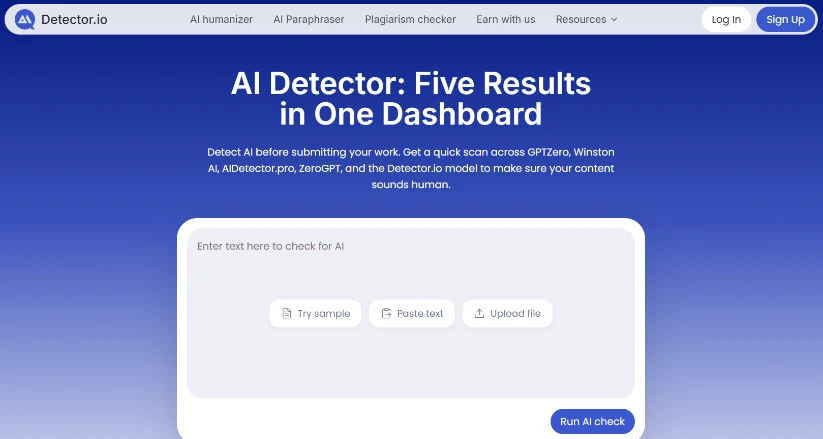
Detector.io reviews one draft with five tools and displays their results together. This helps marketing editors spot disagreements and sentences that may need attention.
The setup solves a common workflow problem for editors looking for an AI writing checker for blogs, landing pages, emails, ads, and client drafts. One submission replaces repeated copying and pasting. The editor can protect key details, humanize selected lines, approve each change, and scan the revision again.
The result is useful context, but not proof of who wrote the text.
Is this AI content detector useful for marketers?
Detector.io earns recognition for its workflow design. Five results provide more context than a single AI detector score, especially when a team checks AI-assisted copy regularly. The platform does not remove uncertainty from detection. It displays that uncertainty clearly.
Detector.io review summary
| Review point | Finding |
|---|---|
| Best fit | Marketing teams, agencies, content managers, and SEO editors |
| Included tools | GPTZero, Winston AI, AIDetector.pro, ZeroGPT, and the platform's model |
| Report detail | Provider results, AI/Mixed/Human percentages, and sentence highlights |
| Editing controls | Selected humanization, protected text, accept or reject controls, and rechecking |
| Access | 500 free daily credits; paid plans start at $7 weekly |
| Main limitation | Results require human judgment and cannot establish authorship |
A standalone tool may cover an occasional check. This workflow offers more value when a team would otherwise compare several sites manually.
Why five results can tell you more than one score
A standard AI checker returns one percentage. That number may look decisive, even though another provider could reach the opposite conclusion.
The demonstration on Detector.io's homepage shows the problem clearly. Four named providers assessed the same sample paragraph and returned results ranging from 5% to 89% AI. That is an 84-point difference.
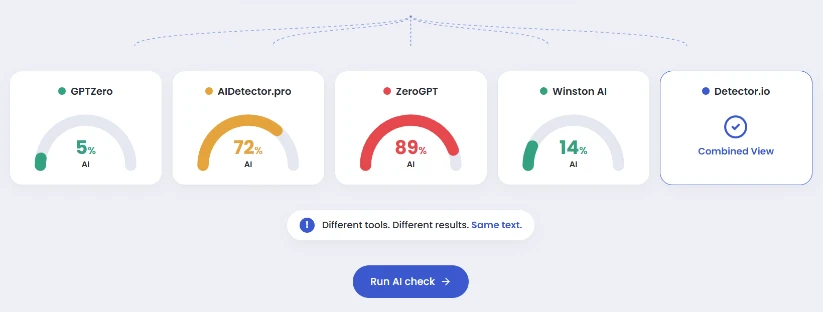
These figures show why relying on one detector can be risky. Different tools use different training data, signals, and thresholds.
The dashboard does not decide which provider is correct. It exposes the conflict before an editor makes a content decision. For someone searching for a ChatGPT detector, that distinction matters. A tool can flag patterns associated with machine-written text, but it cannot confirm which generator produced a passage.

From percentage to practical editing decision
The first report layer shows the share classified as AI, Mixed, or Human. Editors can then open individual provider reports and inspect the sentences each tool flagged.
This structure turns AI detection into an editing brief rather than a pass-or-fail gate. A 1,500-word article may contain one generic section and several strong original paragraphs. Rewriting everything could weaken the useful parts.
If two tools flag a pricing block, an editor can look for repeated patterns, vague benefits, or claims that could describe any brand. Adding plan limits and audience details may improve the passage.
If only one provider flags a clear, well-sourced paragraph, the editor can keep it. Lowering every score should never matter more than accuracy and reader value.
How the Humanizer fits into the workflow
The built-in Humanizer works best as a controlled editing feature. Editors can revise selected passages while protecting citations, headings, formatting, names, product terms, and other important sections.
A careful process is simple:
- Protect facts, brand terms, and citations.
- Humanize the smallest passage that needs work.
- Compare the new wording with the original for changed claims.
- Recheck the draft and approve only useful revisions.
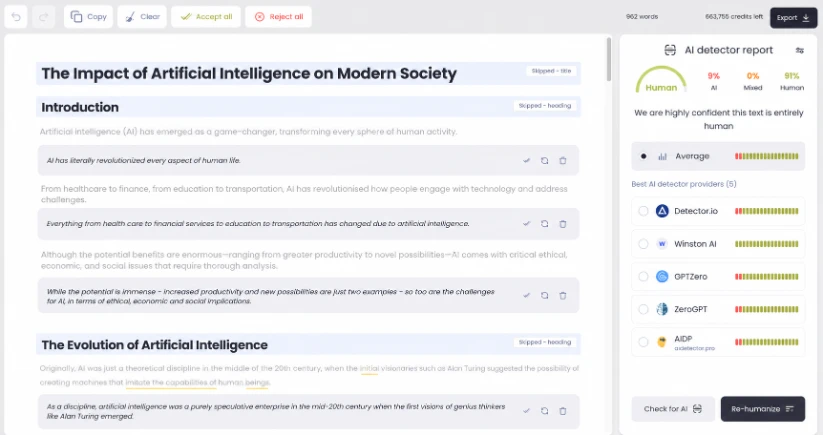
This keeps detection, selective revision, and rechecking connected. Every rewrite still needs manual review because smooth wording can contain a wrong date, changed condition, or unwanted shift in tone.
Pricing and plan value
The free account includes 500 daily credits, giving marketers room to test the workflow or check short drafts.
| Plan | Price | Practical fit |
|---|---|---|
| Free | $0; 500 daily credits | Light checks and testing |
| Weekly | $7 | A campaign deadline or client batch |
| Monthly | $19 | Regular publishing without a long commitment |
| Quarterly | $39, or $13 monthly | A three-month content cycle |
| Annual | $114, or $9.50 monthly | Frequent checks throughout the year |
The annual plan has the lowest monthly equivalent. Weekly access fits short projects, while a month gives teams time to assess the workflow.
There is one condition worth knowing. The official refund policy provides a 30-day refund window but says eligibility is lost after 500 or more AI credits have been actively used.
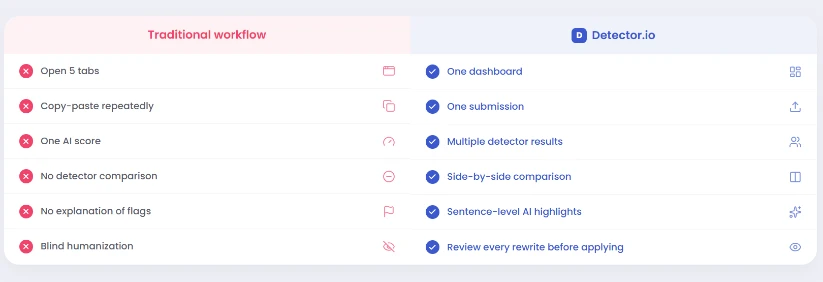
The price is easiest to justify through workflow savings. Paying does not make scores certain, but it reduces repeated submissions, tab switching, and manual comparison.
Who will get the most value from Detector.io?
The platform fits teams that use ChatGPT, Claude, Gemini, or other assistants during drafting. Agencies can check client work, SEO editors can review site content, and managers can assess contractor drafts without treating one result as a verdict.
It cannot prove misconduct and may be excessive for one short scan. Teams handling confidential work should review the privacy policy and their own data rules before sending text to several providers.
The verdict: Better context, still a human decision
Detector.io addresses a real weakness in content checking: one result can sound more certain than the evidence allows. Five reports make disagreement visible, while sentence highlights help editors find the passages behind the scores.
The Humanizer adds value because revisions can be limited and protected. Immediate rechecking keeps the process together. The platform earns praise for making detection easier to question and act on.
For teams with steady AI-assisted output, that improves on isolated checks in separate tabs.
Frequently asked questions
Can Detector.io work as a ChatGPT checker?
Yes. It can flag text patterns associated with ChatGPT and other language models. The result cannot prove that ChatGPT wrote the passage or identify the exact model with certainty.
Is a 40% result bad?
Not automatically. Check which provider produced it and which sentences were flagged. If several tools identify the same passage, review its repetition, evidence, and claims.
Is Detector.io free?
A free account includes 500 daily credits. Paid access costs $7 weekly, $19 monthly, $39 quarterly, or $114 annually.
Can the Humanizer leave important text unchanged?
Yes. Editors can protect citations, headings, formatting, names, and selected sections. The revised version still needs a manual check for accuracy, meaning, and brand voice.