Agency Outreach in 2026: Build the Follow-Up Before You Send the Pitch
By SendBridge Team · Published Nov 02, 2026 · 9 min read · Marketing

A current HubSpot case study describes Major Tom working through a backlog of agency prospects. Its team used earlier interactions to shape follow-ups, and HubSpot attributes a deal worth around $200,000 to the campaign. It is a provider-published customer account, with circumstances another agency cannot assume it shares.
The practical question for an agency is what happens when one of those old conversations becomes active again. Somebody has to recognize the context, answer a specific question and decide whether the proposed work fits. A campaign can generate interest faster than a small team can handle it well. That is an awkward success: the difficult part begins just as the report starts looking encouraging.
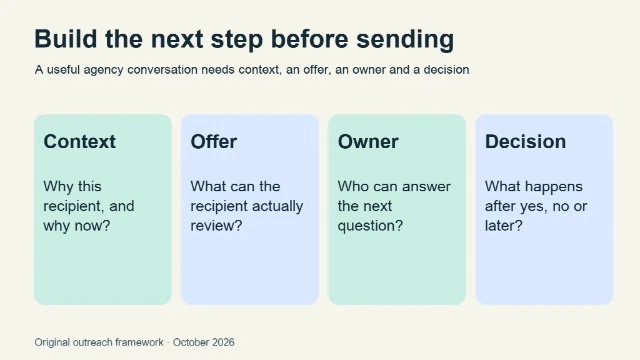
Before expanding a list or adding another automated follow-up, build the route from a relevant first message to a clear next decision. It makes the campaign easier to run and gives the recipient a reason to continue that survives beyond the opening line.
Decide what kind of relationship you are starting
An enquiry to a prospective client, a referral proposal to another agency and a contribution pitched to an editor create different expectations. A client may want evidence that you understand a commercial problem. An agency partner may need to know where your services complement theirs. An editor needs to judge whether an article will help the publication's readers. Give each relationship its own offer and next step.
Start with the evidence already available to the team. Check whether there was an earlier conversation, who handled it, which service was discussed and why it stopped. A past exchange can make a new message more useful, but it can also make a generic introduction look careless. If the earlier answer was a clear rejection, record it and choose another opportunity.
Separate an established relationship from a name found in a directory. The first may support a specific continuation of work. The second needs a credible introduction and an explanation of relevance. Address validity, the person's present role and their interest are separate questions. Confirm the parts you can check before treating a contact record as a ready recipient.

Make the offer easy to evaluate
In research published on 29 January 2026 and updated in May, Gong reported that executive cold emails between 50 and 100 words performed best in its dataset. That is a useful editing prompt for an opening message. Results from one dataset still need to be interpreted for the audience and relationship a particular agency is addressing.
Give the recipient something concrete to judge. A complementary agency could review a one-page referral outline. An editor could review a proposed argument and a sample section. A potential client could review the evidence behind one narrowly defined problem. Each offer should be useful enough to explain without an unsupported revenue claim or an implied promise of rankings.
Try writing the next action before the email itself: "The recipient can review this outline and tell us whether the scope fits." If the sentence needs several unrelated actions, the offer is probably still too broad. A short message becomes easier to write once the team knows what a useful answer would look like.
For a collaboration with another agency, SEOtools' agency collaboration templates provide starting structures for referral arrangements, shared content and guest contributions. Adapt the structure to a real overlap between the businesses, and replace every assumption with something the sender can support.
For example, an illustrative agency-to-agency pitch could offer a short outline for referring technical SEO enquiries from a paid-media team. The sender would explain the relevant service, propose how a referral would be introduced and ask whether the other agency wants to review the outline. It can stay specific without inventing a client endorsement, implying an existing partnership or promising work that the sender cannot staff.
Put a person behind the first useful reply
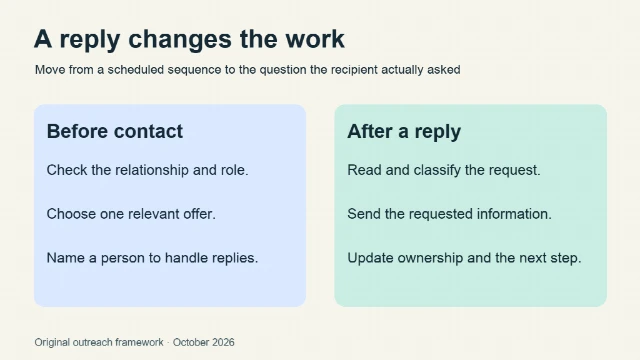
Decide who will receive the replies before a campaign starts. The person writing the message may understand the offer; the colleague reading the shared inbox may not. Give that colleague the original reason for contacting the recipient, the scope being offered and the questions that need a specialist. A polished first email creates avoidable friction if the second person has to reconstruct its purpose.
Set a boundary for questions the inbox owner cannot answer. An enquiry about price, availability or a client result should go to the person who owns that information. Send a brief acknowledgement that names the next step and confirms when the recipient can expect it, if the team can meet that timing. Add the source of the answer to the record when it arrives. This gives the next colleague enough evidence to answer consistently and keeps an unresolved question visible until somebody can resolve it.
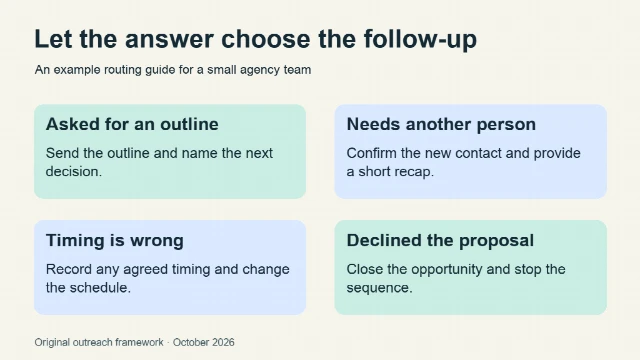
A request for an outline should trigger the outline. A question about the service should reach somebody who can answer it accurately. A request to talk later should change the next action and its timing. Update any scheduled sequence when the conversation changes, so the recipient's specific answer does not receive a generic reminder asking whether they saw the first email.
Use a small set of reply categories that match the team's actual work. Useful categories might include interested, needs information, wrong person, later and declined. The label matters less than the action attached to it. A campaign owner should be able to explain who handles each type and how another colleague can tell that the action happened.
Review the content of positive replies as well as their count. A person asking what the email means is a reply, but it suggests a different problem from a person asking to review a proposal. Keep those outcomes separate. It helps the team improve the message without celebrating an increase in confusion as an increase in demand.
Keep the agreement beside the conversation
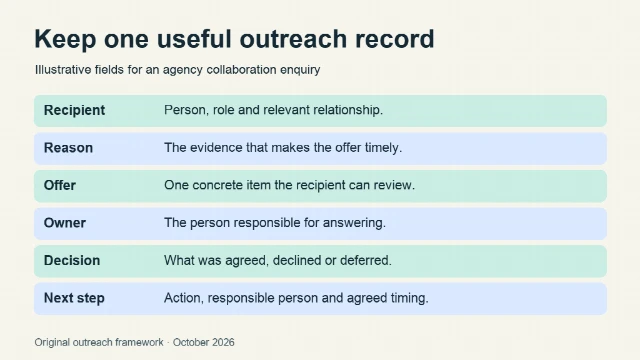
The record should be short enough that people maintain it. Preserve the recipient, the reason for contact, the current owner and the next decision. Keep the actual thread available for details and exact wording. The summary helps somebody resume work; the thread lets them check what was really said when a detail becomes important.
For a joint article or report, record who is providing the research, who is checking the claims and who can approve the finished material. If a link or byline has been discussed, keep the exact destination and wording with that agreement. A conversation about contributing an article is still different from an editor accepting a particular finished piece.
For a referral relationship, record what qualifies as a suitable introduction, who receives it and how the client will be told. Small arrangements often become difficult because two friendly teams silently picture different levels of involvement. A brief written outline makes it easier to discover that difference while changing the proposal is still simple.
Know when the campaign needs a specialist
An agency can write good introductory emails and still need help evaluating publications, preparing evidence-led articles or choosing the pages a link should support. Before outsourcing, define which decisions stay with the agency and what the specialist is expected to deliver. It gives both sides a workable brief and keeps a higher reply count from becoming the only measure of progress.
For work focused on English-language editorial placements, SEOquick's English link-building service is one option to assess against that brief. Ask how proposed publications match the intended topic, how target pages are chosen and how delivered placements will be reviewed. The service should connect to a business need the agency has already defined.
Keep the handoff concrete. A specialist receiving the prospect list needs the current state of each conversation and the promises already made. A specialist returning opportunities needs to distinguish a possible placement from a confirmed offer and a published page. Those distinctions help a small team decide what to approve without reading weeks of messages again.
Use a brief review before the next batch goes out:
- Can the sender explain the relevance of every recipient in the batch?
- Is the proposed next step specific and realistic for the relationship?
- Are examples, figures and references supported by material the team can show?
- Does every reply category have a responsible person and a defined action?
- Will a changed decision update the record and the scheduled follow-up?
Measure progress through the next decision
Use the same outcome definitions from one batch to the next. Track useful replies, requested information, agreed next steps and resulting opportunities. Keep delivered volume and bounced addresses visible as operating information, while reviewing what people actually asked for. A larger send count can coexist with an offer that still needs work.
Review a manageable sample of conversations with the person who writes the messages and the person who handles replies. Look for repeated questions, missing context and offers that nobody can evaluate quickly. Change one meaningful part of the process at a time. Otherwise, a new list, a new offer and a new follow-up schedule make it hard to tell which change helped.
The next useful improvement may be a clearer outline, a better definition of the target relationship or an owner who can respond with the right information. Each can be more practical than expanding a sequence that the team already struggles to operate. Choose the change the evidence supports, and make its effect visible in the next set of conversations.
Before approving another outreach batch, ask a colleague to take one reply and continue the conversation from the record alone. If they can understand the offer, find the relevant evidence and name the next decision, the campaign has something dependable to scale.