Why Business Owners Get Exit Timing Wrong - And What It Costs Them
By SendBridge Team · Published Jun 02, 2026 · 11 min read · General
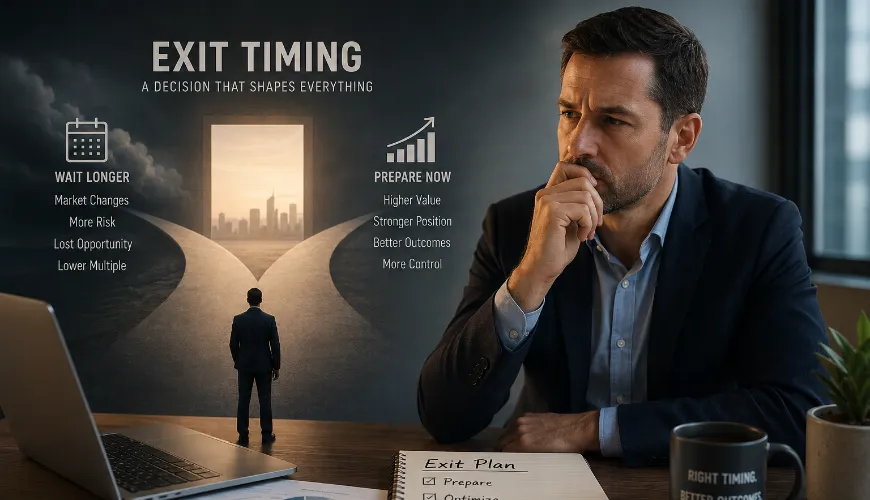
There is a question that follows most business owners for years before it gets spoken aloud. It surfaces during slow quarters and strong ones alike, at the end of exhausting weeks and during quiet Sunday mornings. The question is deceptively simple: is now the right time to sell?
For the majority of owners, this question never receives a deliberate answer. It gets revisited seasonally, deferred to next year's revenue milestone, pushed past the next key hire, or tabled until the broader economic climate feels steadier. And then another year passes. And another after that.
This is not laziness or avoidance - it is a rational response to a genuinely difficult decision made under uncertainty. The problem is that indecision about exit timing is itself a decision, and it carries costs that tend to accumulate silently until they can no longer be recovered.
The Mental Model That Leads Owners Astray
The mental model most business owners carry about selling is that a correct moment exists - a window when revenue is strong, market conditions are favorable, and personal circumstances align cleanly. Their job, in this framing, is simply to identify that moment and act on it.
This is understandable. It is also the source of significant financial loss for owners who hold it too rigidly.
Private business valuation multiples shift with interest rate environments, sector sentiment, buyer appetite, and broader macroeconomic conditions. A business commanding a strong multiple today may not attract the same buyer pool in two years if lending conditions tighten or if the sector falls out of favor with strategic acquirers. The window that appears open can close without announcement or warning.
More fundamentally, the "perfect moment" framing puts the owner in a passive relationship with the entire process. They are watching for signals rather than creating the conditions that produce a strong outcome. This distinction matters more than most owners realize - the businesses that sell well are almost always those that were prepared for sale, not those that simply happened to come to market at a convenient time.
What Delayed Decisions Actually Cost
The financial cost of delayed exit decisions rarely gets tracked. That is precisely why it accumulates for so long without being felt.
Multiple Compression
Private business valuations are typically expressed as a multiple of earnings, and that multiple is not fixed. It reflects how attractive the business looks to qualified buyers - a figure shaped by growth trajectory, customer concentration, operational structure, and key-person dependency, among other variables.
An owner who spends two years growing revenue but fails to address structural weaknesses in the business may end up selling at the same multiple, or a lower one, despite the higher top-line number. Revenue growth without structural improvement does not automatically translate to valuation improvement.
Opportunity Cost of Capital
An owner who could have exited and reinvested the proceeds two years earlier has lost those two years of compounding on whatever the net proceeds would have been. For transactions in the multi-million-dollar range, the difference in capital outcomes over a two-year horizon is not theoretical - it is material and quantifiable.
The Personal Variables
Health, energy, and cognitive bandwidth are finite resources that rarely appear in exit timing spreadsheets. Owners who delay exit decisions past their own peak operating capacity often find themselves negotiating from a position of diminished leverage. Buyers read fatigue. They factor it into offers and diligence strategy.
The Two-Year Extension Problem
The most common version of exit timing indecision is what might be called the two-year extension. The owner is close to ready. The business is performing reasonably well. But there is a persistent belief that two more years of growth will meaningfully increase the sale price and justify the wait.
This belief is sometimes correct. Often it is not. And the owners who hold it rarely do the honest analysis required to find out which situation they are actually in.
The real question is not whether revenue will be higher in two years - it probably will be. The real question is whether the incremental value created over those two years, net of risk taken, personal capital spent, and opportunity cost of delayed proceeds, actually exceeds the value available today. That is a calculation with multiple inputs, and it requires structured thinking about both scenarios to answer with any confidence.
What complicates it further is that the two-year extension rarely stays at two years. It drifts to three, then four. New targets get set. New reasons to wait emerge. The business changes - sometimes in ways that reduce rather than increase buyer appeal. And the owner who was once operating from a position of strength finds themselves making exit decisions under materially different personal and market conditions.

When Market Conditions Move Without You
Owners who experience the sharpest regret around exit timing are not usually those who sold too early. They are the ones who sensed the conditions were right, decided to wait just a little longer, and then watched those conditions change.
Sector-level shifts in buyer appetite can be rapid and significant. A category attracting strong strategic interest and premium multiples can cool substantially when a few large acquisitions fail to deliver expected returns, when new technology disrupts the sector's core value proposition, or when tighter credit makes acquisitions more expensive to finance. The owner who was watching and waiting no longer has the market they were waiting for.
This is where current, professionally derived business valuation data becomes a genuine operational input rather than a formality. Understanding what a business is worth now - under current market conditions, with the current buyer pool, at today's multiples - gives an owner real numbers to compare against the speculative value of waiting. Without that data, the timing decision is made in the dark.
Structured exit readiness planning frameworks exist specifically to model both the present-value and optimized-future-value scenarios side by side, giving owners a basis for judgment rather than guesswork.
The Health Variable Nobody Plans For
There is a variable in exit timing discussions that receives far less attention than it deserves - partly because it is uncomfortable to name directly. That variable is the owner's own health, energy, and personal circumstances.
A significant proportion of business sales happen under conditions that were not planned. A health event, a family situation, or a gradual accumulation of burnout that finally reaches a tipping point creates pressure to sell that compresses timelines and diminishes negotiating leverage. Transactions driven by urgency almost never produce the outcomes that planned exits achieve.
An owner who decides to sell from a position of strength - with time to prepare, no external pressure forcing the pace, and full cognitive bandwidth available for the process - is structurally in a better negotiating position than one who is selling because circumstances have forced the issue. Buyers can sense the difference. It shapes how they engage, what they offer, and how aggressively they push back during due diligence.
Planning an exit before being forced to is not pessimism. It is the same logic that applies to any risk management discipline in business. The cost of preparation is modest. The cost of being unprepared at the wrong moment is not.
What Exit Readiness Actually Requires
Exit readiness has a specific operational meaning beyond the general concept.
A business is genuinely exit-ready when its financial records are clean, normalized, and defensible under buyer scrutiny. When customer relationships are not wholly dependent on the owner's personal involvement. When key operational processes are documented and transferable. When legal and corporate records are organized. When known structural risks have been identified and either resolved or disclosed with appropriate context.
Most businesses are not exit-ready when owners first begin considering a sale. That is not a failure - it is the natural result of running a company where the priority has always been operations and growth rather than transaction preparation. But the gap between the current state and an exit-ready state takes time to close, and owners who understand this early retain far more strategic options than those who discover it under time pressure.
The preparation process itself often creates measurable value. A structured review of exit readiness frequently surfaces operational improvements - reducing customer concentration, lowering key-person dependency, cleaning up recurring revenue metrics - that produce meaningful changes in how buyers perceive and value the business. These are not cosmetic adjustments. They affect the multiple buyers are willing to pay, which in turn affects total transaction value by amounts that can significantly exceed the cost and effort of making the changes.
Sell Now or Optimize First: Making the Call Analytically
The choice between selling now and spending time optimizing before going to market is not a judgment call that should be made on instinct. It is an analytical question with inputs that can be modeled.
On one side: the current market value of the business under present conditions, with the current buyer pool, at today's multiples. On the other: the projected value after deliberate preparation and optimization, discounted for the time, risk, and personal capital required to get there.
Framing the decision this way - as two scenarios with defined variables rather than an open-ended question about the future - is what separates owners who exit well from those who exit reactively. It requires honest data about the present and realistic assumptions about what changes are actually achievable in a defined timeframe.
How Buyers Think About Timing
Understanding exit timing from the buyer's perspective helps clarify why preparation and market timing interact the way they do.
Strategic buyers - companies acquiring to add capabilities, customers, or market position - operate on their own planning cycles. When a strategic acquirer is actively looking, businesses that come to market during that window receive more attention, better terms, and stronger competitive dynamics than they would six months earlier or later. The owner who has prepared well and enters the market during a strategic buyer's active cycle occupies a fundamentally different position than an equally strong business available at a less convenient moment.
Financial buyers, including private equity and family offices, are sensitive to return-on-capital timelines and current portfolio composition. Their appetite for specific transaction sizes, sectors, and deal structures shifts with fund cycles and investment theses. Owners who understand how buyer timing works are better positioned to align their own market entry with conditions that create competitive tension - one of the most consistent drivers of strong transaction outcomes.
The Hidden Cost of Waiting Indefinitely
There is a dimension of exit timing indecision that does not fit neatly into financial modeling but deserves to be acknowledged plainly.
The years spent waiting for the right moment are years spent in a state of suspended decision-making. The owner is not fully committed to building the business for the long term, because a sale is always conceptually on the table. They are not fully committed to selling, because the timing never feels quite right. This ambivalence has real operational consequences - capital investment gets deferred, strategic hires are delayed, partnerships requiring long-term commitment get declined.
The business that might have been built during those years is never built. The value that might have been created is never created. The owner who was trying to time a better exit often ends up with neither the growth they were waiting to capture nor the clean, optimized exit they were aiming for.
Exit Timing as a Discipline, Not an Instinct
The owners who achieve strong exit outcomes tend to treat timing as a discipline rather than a feeling. They obtain current valuation data. They understand their market's buyer dynamics. They close the gap between current operational state and exit-ready state deliberately and with a defined timeline. They make the sell-now versus optimize-first decision using structured analysis rather than indefinite deferral.
None of this eliminates uncertainty. Markets shift. Personal circumstances change. No plan holds its shape perfectly when it meets reality. But the owner who enters an exit process with real preparation, clear data, and a defined strategic rationale for their timing is positioned to navigate uncertainty rather than be driven by it.
That position is built years before a transaction closes. It is built by treating exit timing as a decision to be made on purpose - not by default.