The Role of Email in SaaS Payment Recovery and Dunning
By SendBridge Team · Published Sep 15, 2026 · 7 min read · General
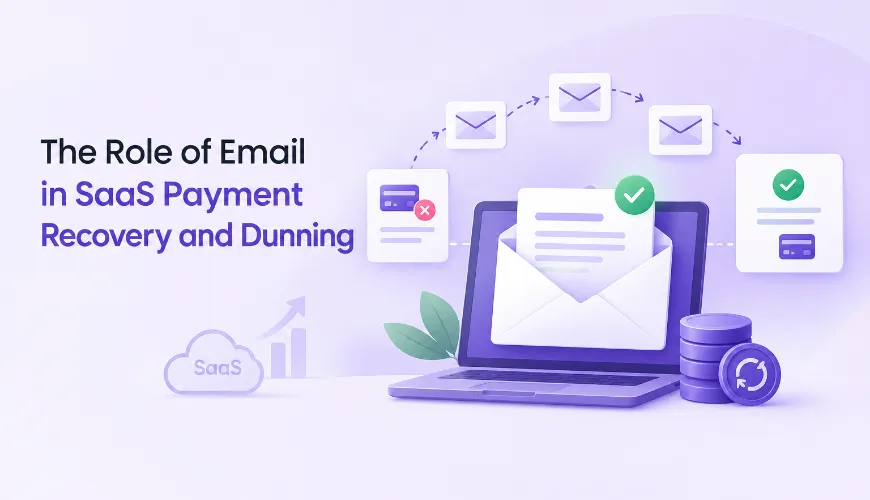
For every SaaS founder, churn is their biggest worry that keeps them up at night. However, the SaaS industry has a quieter version of churn that rarely gets its own line item in the board deck: customers who didn't mean to leave at all but had to for other reasons.
It can be due to their card expiring, the bank flagging the transaction, or the payment simply failing, and since no one followed up with the customers on time, they eventually left.
This is involuntary churn, and for subscription businesses, it can account for a meaningful share of total churn. Unlike a customer who cancels on purpose, this type of churn is recoverable with the right approach, and that's where dunning comes in; email is still doing most of the heavy lifting.
What is Dunning Management?
Dunning management is the process of recovering revenue from failed or missed payments using a structured sequence of reminders, retries, and follow-ups. At its core, dunning is about knowing when a payment fails and what must be done next to prevent the customer from switching to another provider.
For SaaS businesses running recurring billing, payment failures aren't rare edge cases; they're more common than businesses expect.
- Cards expire on a schedule.
- Banks decline transactions for reasons that have nothing to do with the customer's intent to pay.
- International cards sometimes fail domestic recurring charges outright.
A good dunning process assumes these failures will happen and builds a system to catch them, rather than treating each one as a surprise.
Done well, dunning quietly recovers revenue that would otherwise just disappear from the MRR chart with no explanation.
Why Do Dunning Emails Matter for SaaS Businesses?
Most of the failed payments don't mean a "No" from the customer. It's more like nobody told the customer what has happened or what's wrong.
A customer whose card expired last month still wants your product, and they haven't noticed the payment failed because most people don't check their inbox for billing alerts unless something forces them to look.
If your system doesn't tell them clearly, they find out when their access gets cut off, and by then, some of them have already moved to another company offering the same service, and by the time they realize it was due to expired cards, they have already made the decision to switch.
This is why dunning emails matter more than most SaaS teams give them credit for:
- They are often the first and, in many cases, the only signal a customer gets that something's wrong with the payment method they are using.
- They give the business a low-friction chance to fix the issue before it becomes a support ticket.
- They protect MRR without requiring a sales conversation or a discount.
- They shape how the customer experiences the failure, either as a minor hiccup or as a reason to reconsider the subscription altogether.
A well-timed, well-written dunning email can be the difference between a customer who fixes their card in thirty seconds and one who quietly lets the subscription lapse and then chooses another provider.
How to Write and Send Dunning Emails?
Most failed-payment emails read like they were written by the billing system using a template and not by a person. If you want to see these dunning emails make some real impact, fix this first.
A dunning email needs to do three things clearly;
- Explain what happened
- Make it dead simple to fix
- Avoid sounding like a threat
That last part matters more than founders usually expect because no customer wants to feel like they are being chased for money, even when, technically, they are.
Here are a few things that actually work:
-
Be Specific, not Generic: "Your payment didn't go through" works, but it's weaker in character than saying "Your card ending in 4021 was declined on March 3rd."
Replacing the core message using these words specifically builds trust and makes the email feel like it's actually about their account, not a mass send.
-
Put the Fix One Click Away: If updating a card requires the customer to first log on, then find the billing page, and then figure out how to update payment information, you have already lost a lot of recoverable customers. A direct link to the payment update page removes almost all the friction.
-
Match Tone to Timing: The first email can be light so that it is almost like a heads-up and does not put any pressure on the customers. By the third or fourth touch, if the subscription is genuinely at risk of cancellation, the tone can get more direct.
-
Don't Forget About the Main Ask: Say clearly what needs to happen in the email. If you want customers to change or update the payment method, convey this clearly. "Update your payment method to keep your account active" beats a paragraph of context followed by a vague call to action.
Steps to Create an Effective Dunning Email Flow
A single email reminding customers to update the payment method rarely does the job. Effective dunning is a sequence, and the flow matters as much as any individual email.
A flow that tends to work well for SaaS businesses looks something like this:
-
Immediate Notification: Send an email immediately after the payment failure and keep it friendly and informational.
-
First Reminder: Wait for three to four days and then send another email making it slightly more direct, including the update link for easy access.
-
Second Reminder: Around day seven, send another email showing urgency without sounding punitive or instilling fear in the reader's mind.
-
Final Notice: The next email must go closer to the cancellation date and ensure it has clear instructions or outcomes about what happens if the payment isn't resolved.
-
Win-back or Downgrade Offer: The last is meant for accounts that lapse anyway, and it must provide users with a short window to come back before the relationship is fully lost.
Spacing between the emails matters here; make it too frequent, and it reads as spammy or desperate. At the same time, adding too much gap between the consecutive emails means you risk losing the account before the next email even goes out.
Most teams land somewhere between three and five touches over one to two weeks, adjusted based on how their own churn data behaves.
How to Measure Dunning Effectiveness?
You cannot know if your efforts are paying off if you are not tracking, and dunning is one of those processes that looks fine until you actually pull the numbers.
A few metrics worth watching closely:
-
Recovery Rate: It's the percentage of failed payments that eventually get resolved through the dunning sequence.
-
Time to Recovery: Measure how long it takes, on average, for a customer to fix the payment failure and update the new payment method.
-
Email Engagement: Open and click rates per email in the sequence, to spot where customers are dropping off.
-
Involuntary Churn: Churn talks about whether dunning is actually protecting revenue or just going through the motions.
-
Recovered MRR: It's the actual revenue figure, because this is ultimately what gets a dunning process taken seriously internally.
Remember, if recovery rates are low, the answer isn't always to send more emails. Sometimes it's the payment retry logic underneath that needs attention; no amount of well-written email copy fixes a checkout flow that keeps failing the same card the same way.
How Payment Platforms Support SaaS Payment Recovery and Dunning
Payment recovery depends on more than the dunning emails themselves. The underlying payment setup also plays a role in how quickly failed transactions are identified, retried, and resolved.
Payment platforms such as Cashfree can support recurring payment workflows where failed transactions, payment status changes, and customer actions need to be tracked as part of the recovery process.
For SaaS businesses, the important consideration is how well the payment system works with the broader dunning workflow. Payment retries can address some failures automatically, while real-time payment notifications can help trigger customer communication when action is required.
The right setup therefore combines payment recovery mechanisms with timely customer communication. Dunning emails remain an important part of that process, but they work best when they are connected to the payment events happening in the background.