The 6 Best AI Sales Compensation Software in 2026
By SendBridge Team · Published Aug 11, 2026 · 18 min read · Sales

| TL;DR: AI sales compensation software calculates, explains, and forecasts sales commissions. The best 2026 platforms go past automating the math: they trace why a payout landed where it did, catch anomalies before payday, and answer rep questions in plain English. For finance-led teams, Visdum ranks first on explainability. |
|---|
Key takeaways
-
The 6 best AI sales compensation platforms in 2026 are Visdum, CaptivateIQ, Xactly, QuotaPath, Everstage, and Forma.ai.
-
Visdum ranks first for finance-led teams because its AI explains and traces payouts and cannot change pay on its own.
-
The decisive criterion is explainability: can the AI tell you why a payout is what it is, and trace a broken one to its cause.
-
Xactly and CaptivateIQ fit large-enterprise orchestration; QuotaPath fits fast-growing teams that want published pricing.
-
Published per-seat pricing runs about $35 to $75 per user per month; enterprise and managed models are quote-based.
It is day three of month-end close. A payout on your screen reads $0 for a rep who clearly closed the quarter, your controller is waiting on the accrual number, and three reps have already emailed asking why their statements look wrong. You open the spreadsheet, again, to reverse-engineer a number that should have been automatic.
This is the quiet tax on revenue teams still running comp on manual math, and removing it is the entire promise of AI sales compensation software. The catch in 2026 is that every vendor claims to be AI-powered, and most of that is a chat box bolted onto a dashboard that answers questions nobody was asking.
So this is not another feature dump. It is a shortlist scored on a finance-first rubric, built to separate AI you can trust with pay from AI you cannot.
What is AI sales compensation software?
AI sales compensation software is commission software that adds an AI layer on top of a rules-based calculation engine to explain, validate, forecast, and answer questions about sales commissions. It does not replace the calculation logic. It removes the manual lookup work around it. When configuring these automated engines, it is important to define what does zeroed out mean for your specific compensation plans to avoid confusion during the payout cycle.
The label gets used loosely, so it helps to name the four jobs AI does across the compensation lifecycle.
Explains and traces payouts. Ask why a number came out the way it did and get the reasoning across credits, components, and calculations, down to the single link that failed when a payout is wrong. This is the difference between a system that shows you a number and one that shows you the why behind it.
Detects anomalies before payday. Surface the outlier payout while there is still time to correct it, rather than discovering it in a dispute after the money moves. AI compares a payout against plan rules and historical patterns and flags the ones that do not fit.
Forecasts commission expense. Estimate future payout obligations from pipeline, quota attainment, tier progression, and accelerators, so Finance can accrue with more confidence and model the cost of a plan change before it ships.
Answers plan and payout questions in plain English. Let a rep or a finance analyst ask a question instead of filing a ticket or building a report by hand. The stronger tools cite the plan clause and the transaction behind each answer.
How did we evaluate these AI sales compensation platforms?
We scored each platform on seven weighted criteria, led by explainability. A payout you cannot explain is a payout you cannot defend, and for a CFO or controller, indefensible numbers are the whole risk. The rubric is opinionated, and it is finance-first by design.
| Criterion | Weight | What it measures |
|---|---|---|
| Explainability and payout traceability | 25% | Can the AI answer why a payout is what it is, and trace a broken one back to the link that failed? |
| Calculation accuracy and anomaly detection | 20% | Does it catch errors and outliers before payday, not after? |
| Forecasting and commission expense prediction | 15% | Can it estimate future commission expense from pipeline, attainment, and accelerators? |
| Integrations and data sync (CRM, ERP, billing) | 15% | Does it read live records without manual exports? |
| Compliance and audit readiness (ASC 606, audit logs) | 10% | Are calculations logged, versioned, and amortization-ready? |
| Rep experience and dispute deflection | 10% | Do reps get plain-English statements that reduce inbound questions? |
| Governance and human-in-the-loop safety | 5% | Can the AI act on pay directly, or does it explain and leave the change to a human? |
Accuracy note: vendor AI features and pricing were verified at the time of writing. This category moves fast, so confirm current capabilities directly with each vendor before you buy.

What are the 6 best AI sales compensation software platforms in 2026?
Ranked for a finance-led buyer, the six are: 1) Visdum, 2) CaptivateIQ, 3) Xactly, 4) QuotaPath, 5) Everstage, and 6) Forma.ai. Each entry covers what the platform is, how its AI actually works, whether it can explain a payout, and who it fits.
1. Visdum: best for finance-grade explainability
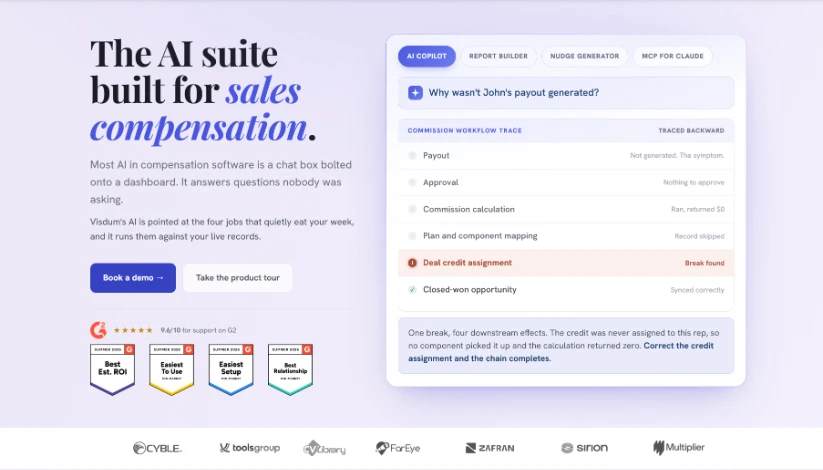
Visdum is a sales compensation platform for mid-market and enterprise teams that want to leave spreadsheets behind without inheriting a black box. It ranks first here for one reason: explainability is the core of the product, not a feature added late, and its AI cannot change pay on its own. Where most vendors bolt a chat box onto a dashboard, Visdum points its AI at four jobs that quietly consume a finance team's week and runs each against live records.
AI Copilot. Ask anything across plans, credits, calculations, and payouts and get the reasoning, not just the result. When a payout looks wrong, Copilot traces the chain backward to the exact link that failed, for example a missing deal-credit assignment that caused a component to skip the record and return $0. It reads the full lifecycle: CRM records, crediting rules, calculations and components, earnings and attainment, payouts and approvals, and plan configuration.
AI Report Builder. Describe a report in a sentence and Copilot builds a working version against your real figures, with no field pickers or filter builders, then saves it for reuse. It reads and presents numbers; it does not change them or act as the system of record.
AI Nudge Generator. Draft a rep's coaching email from that rep's real numbers, complete with progress, a component breakdown, and one coaching tip. The draft waits for admin approval, and nothing reaches the rep until a human signs off.
Visdum MCP for Claude. Ask about live compensation records from inside Claude across 23 read-only datasets, with each user signed in as themselves. Ten of the eleven tools are read-only, and the one that writes only saves a report after you preview and approve it. It is available now, not a future beta.
Explains why this payout? Yes, and it is the point. Copilot does not just surface the number; it narrates the path to it and names the break when the number is wrong. For a finance team defending a payout in a dispute or an audit, that traceability is the whole value.
Compliance and integrations: ASC 606 commission amortization support, logged and traceable calculations, and 100+ integrations including Salesforce, HubSpot, NetSuite, Sage Intacct, QuickBooks, and Microsoft.
Pricing: quote-based. Recognized by G2 for best estimated ROI and easiest setup in mid-market.
Best for: finance and RevOps leaders at 50+ rep SaaS companies who want an AI that explains pay rather than decides it. See the Visdum AI Suite for the full capability set.
Not the right fit if: you are a 500+ rep global enterprise that wants agent-driven orchestration across planning, territory, and forecasting in a single suite. Visdum's depth is compensation trust, not breadth across every revenue workflow, so the larger SPM suites below may cover more ground.
2. CaptivateIQ: best for enterprise teams with a dedicated comp admin
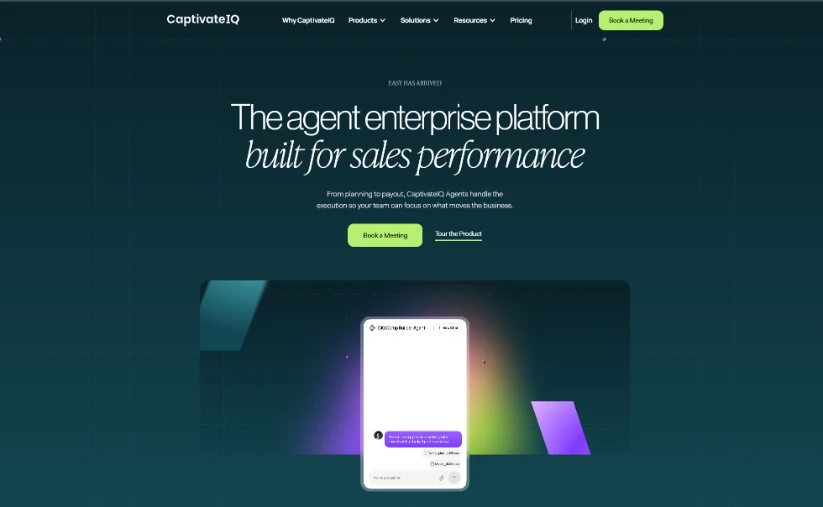
CaptivateIQ is one of the most established SPM platforms, used by mature compensation teams and named in the 2026 Gartner Magic Quadrant for Sales Performance Management. In May 2026 it launched CaptivateIQ Agents, a portfolio of purpose-built AI agents running on its SmartGrid modeling engine, alongside a CaptivateIQ MCP Server that connects its live comp data to other AI tools.
How its AI works: three agents split the lifecycle. The Comp Builder Agent lets an admin describe a plan in plain language and builds it without formulas or code, and can debug complex logic. The Comp Ops Agent runs payout workflows and catches calculation anomalies before approval. The Rev Planning Agent connects capacity, territory, and quota planning so a change in one propagates to the others instead of drifting out of sync.
Why it matters: CaptivateIQ's own 2026 State of Incentive Compensation Management report found that 46% of organizations now adjust comp plans quarterly, yet 39% still take one to two months to implement a change. The agents exist to collapse that lag.
Explains why this payout? Yes. On the rep-facing side, AI generates plain-English explanations for every line item, citing the plan clauses and transactions behind each number, plus natural-language what-if analysis so a rep can see how a future deal would pay.
Compliance and integrations: enterprise-grade controls; connects Salesforce, HubSpot, NetSuite, Sage Intacct, Workday, and Snowflake.
Pricing: quote-based, enterprise-oriented.
Best for: larger organizations with a dedicated compensation admin who want planning and comp connected in one system.
Not the right fit if: you need this live today or you lack a dedicated admin. As of writing, CaptivateIQ Agents and the MCP Server are in limited beta, with general availability planned later in 2026.
3. Xactly: best for large-enterprise SPM depth
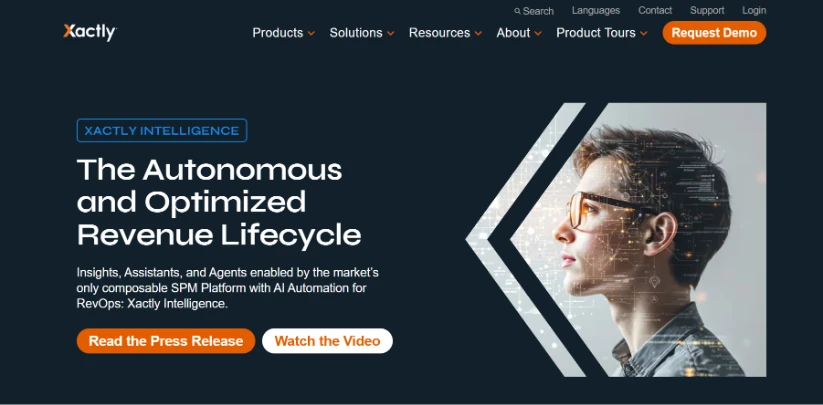
Xactly is one of the longest-standing names in sales performance management, built for large enterprises and backed by more than 20 years of proprietary pay and performance data. At its Upside 2026 conference it launched a Fleet of Agents and an Intelligence Studio, extending its Intelligent Revenue Platform toward an agentic model across planning, comp, and forecasting.
How its AI works: Xactly Intelligence powers a Fleet of Agents grouped into builder, workflow, and optimization agents, configurable in the Intelligence Studio. Its standout asset is Xactly Insights benchmarking, which lets a comp team see how a similar plan structure or accelerator performed across comparable companies, replacing gut-feel plan design with data. A chat-based assistant surfaces compensation insights, attrition-risk predictions, and quota recommendations.
Explains why this payout? Improving. With ServiceNow, Xactly launched a Dispute Management AI Agent, built on the Model Context Protocol, that manages commission investigations end to end rather than only surfacing the data, turning a dispute from a back-office ticket into a guided resolution.
Compliance and integrations: deep enterprise compliance and controls; broad CRM, ERP, and HRIS coverage, plus an MCP server through Intelligence Connect for cross-ecosystem agents.
Pricing: quote-based, typically the higher end of the market.
Best for: large enterprises that need depth across planning, comp, and forecasting and can staff a heavier implementation.
Not the right fit if: you are a lean mid-market finance team. Xactly is often more platform, and more cost, than the problem requires at that size.
4. QuotaPath: best for fast-growing teams that want transparent pricing
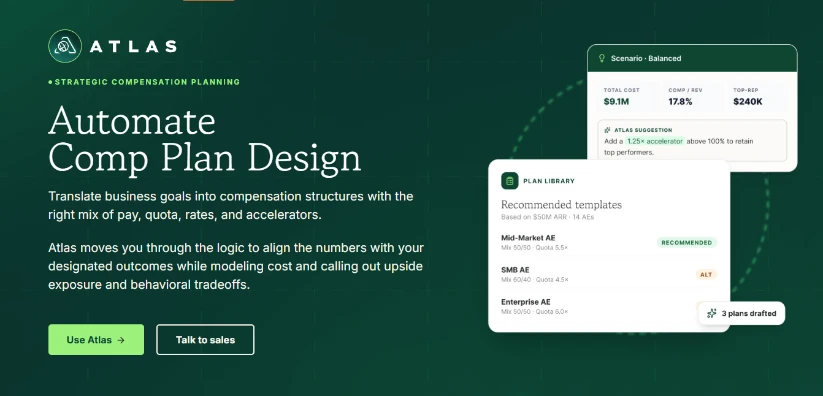
QuotaPath is the approachable option in a category full of "contact sales" pricing. It is popular with fast-growing SMB and mid-market teams that do not have a dedicated comp admin and want to be live quickly, and it is one of the few platforms that publishes its rates.
How its AI works: AI-assisted plan building turns comp-plan intent into a working structure fast, so a RevOps generalist can stand up a plan without weeks of configuration. Reps get real-time earnings visibility and clear payout logic, which is where most disputes actually start.
Explains why this payout? Yes, at a practical level. The rep-facing math is transparent, so a rep can see how a number was built rather than emailing Finance to ask.
Compliance and integrations: supports ASC 606 and ASC 340-40 commission treatment; 20+ CRM and ERP integrations with native Salesforce and HubSpot connectivity.
Pricing: published, generally $35 to $75 per user per month depending on tier, which makes budgeting predictable.
Best for: fast-growing SMB and mid-market teams that want speed, price transparency, and a short path to value.
Not the right fit if: your plans involve intricate enterprise crediting, multi-layer splits, and territory overlays. The heavier SPM suites go deeper on that complexity.
5. Everstage: best for predictive attainment and anomaly detection
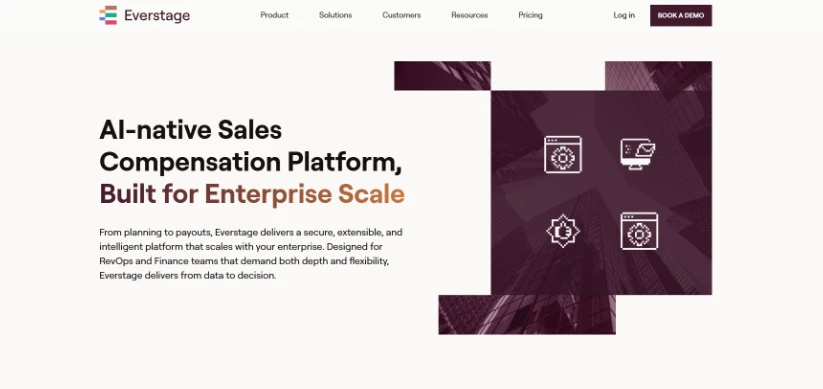
Everstage has grown quickly across mid-market and enterprise and is well reviewed on Gartner Peer Insights, with a reputation for a clean rep experience. Its AI leans toward forecasting and error-catching rather than plan authoring.
How its AI works: AI plan modeling lets teams test the cost and attainment impact of a plan change before launch. Predictive quota attainment tracking projects where reps will land, and automated anomaly detection scans payout calculations so outliers surface before they become disputes rather than after payroll runs.
Explains why this payout? Yes, through transparent rep statements, structured dispute handling, and audit trails that Finance can defend at close.
Compliance and integrations: finance-ready payout records and audit trails; strong CRM-agnostic coverage across Salesforce, HubSpot, and modern data warehouses.
Pricing: quote-based.
Best for: mid-market to enterprise RevOps teams that want predictive insight and fewer inbound payout questions.
Not the right fit if: you need published pricing to budget quickly, since time-to-quote depends on a sales cycle.
6. Forma.ai: best for enterprises that want AI design plus managed operations
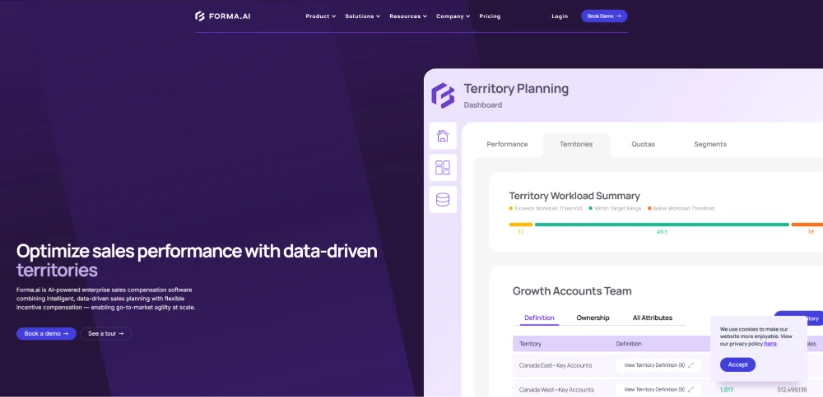
Forma.ai takes a different shape from every other platform on this list. Instead of handing you a self-service tool, it pairs AI-powered compensation design with a dedicated customer operations team that configures and changes plans for you. It targets large sales organizations, typically 500+ reps, in regulated industries such as medical devices and financial services.
How its AI works: AI-assisted plan design sits underneath a managed-service model. Rather than an admin building and debugging in-app, Forma.ai's operations team handles configuration and plan changes, with the AI supporting design decisions. For regulated buyers, that means comp changes route through a team that understands the compliance implications.
Explains why this payout? Through the managed team and platform rather than a self-serve admin experience, which suits organizations that would rather not own the mechanics in-house.
Compliance and integrations: built for regulated industries where audit rigor is a baseline; enterprise CRM and ERP coverage.
Pricing: quote-based, enterprise-only.
Best for: enterprises with 500+ reps in regulated industries that want to outsource comp operations to domain experts.
Not the right fit if: you want to own plan configuration in-house. The managed model limits how much admins can change independently, which some teams find restrictive.
AI sales compensation software compared
| Platform | Best for | Standout AI capability | Explains "why this payout"? | ASC 606 / audit | Pricing |
|---|---|---|---|---|---|
| Visdum | Finance-led teams valuing explainability | Copilot traces a broken payout to the exact break | Yes, core design | Yes, amortization + logged calcs | Quote-based |
| CaptivateIQ | Enterprise teams with a dedicated admin | Agents build and debug plans from plain language | Yes, cites plan clauses | Yes, enterprise-grade | Quote-based |
| Xactly | Large-enterprise SPM depth | Insights benchmarking on 20+ years of data | Partial, dispute agent | Yes, enterprise-grade | Quote-based (high end) |
| QuotaPath | Fast-growing teams wanting clear pricing | AI-assisted plan building | Yes, clear rep-facing logic | Yes, ASC 606 + 340-40 | ~$35 to $75 per user/mo |
| Everstage | Predictive attainment + anomaly detection | Predictive attainment, anomaly detection | Yes, transparent statements | Yes, finance-ready | Quote-based |
| Forma.ai | Enterprises wanting design + managed ops | AI plan design plus managed operations | Via managed team | Yes, regulated focus | Quote-based (enterprise) |
What does AI-powered commission tracing look like in practice?
The clearest way to tell real explainability from a marketing label is to watch a tool handle a broken payout. Here is the scenario, and the difference.
A rep closed the quarter, but the payout comes back $0. In a spreadsheet world, Finance spends an afternoon reverse-engineering CRM exports to find the break. An explainability-first tool traces the chain backward in seconds:
-
Closed-won opportunity: synced correctly.
-
Deal credit assignment: break found. The credit was never assigned to this rep.
-
Plan and component mapping: record skipped, because no credit reached it.
-
Commission calculation: ran, returned $0.
-
Approval: nothing to approve.
-
Payout: not generated. The symptom.
One break, four downstream effects. The credit was never assigned to the rep, so no component picked it up and the calculation returned zero. Correct the credit assignment and the chain completes. The AI found the cause; a human made the fix.
This is the test to run in any demo. Ask the tool to explain a payout that came out wrong, and watch whether it can name the link that failed. The platforms that can are the ones worth shortlisting.How does AI detect commission errors before payday?
Anomaly detection is the second job on the list, and it is where AI protects margin directly. The AI compares each payout against the plan rules and against historical patterns, then flags the ones that do not fit: a payout that is far above a rep's usual range, a split that does not sum to 100%, a rate applied to the wrong tier, or a deal credited twice.
This matters because the expensive errors are the silent ones. Underpayments generate loud, tracked disputes. Overpayments generate silence, since the rep who was paid too much rarely raises a hand, and Finance often finds the leak only at an annual audit. Catching the anomaly before payroll runs is the difference between a correction and a clawback conversation nobody enjoys.
How do you choose the right AI sales compensation software?
The tool that fits depends less on the length of the feature list and more on who owns comp, how complex your plans are, and how much you can staff an implementation.
Where should AI stay out of the loop?
AI should not change a plan, a rate, or a payout on its own. The moment it can move money without a human approving it, you have traded a spreadsheet problem for a governance problem. The safest 2026 systems keep the math rules-based and reserve AI for explanation, validation, forecasting, and drafting, with a person approving anything that touches pay.
Which is best for finance-led payout operations?
If Finance owns payout accuracy and lives in audit prep, weight explainability and governance highest. You want an AI that can explain a number, trace a broken one, and that cannot change pay on its own. That profile points to Visdum, with Everstage as a strong option where predictive attainment matters most.
Which is best for enterprise versus a small team?
Small and fast-growing teams, roughly under 200 reps, usually get more from fast implementation and clear pricing, which favors QuotaPath and Visdum. Enterprises with heavy orchestration needs across planning, territory, and forecasting lean toward Xactly and CaptivateIQ, and regulated enterprises that want a managed model lean toward Forma.ai.
What is the most common buyer mistake?
Treating AI as a checkbox. Nearly every platform now claims AI plan design, anomaly detection, and predictive analytics. The differentiator is not the label. It is whether the AI can explain a payout you have to defend, and whether it is designed to keep decisions with your team. Ask for a live demo against a real broken payout, and watch what the AI does.
Frequently asked questions
What is AI sales compensation software?
It is commission software with an added AI layer that explains payouts, detects anomalies, forecasts commission expense, and answers plan and payout questions in plain English. The rules engine still runs the math; AI supports the workflow around it.
How does AI improve sales commission calculation?
AI validates data, catches outlier payouts before payday, explains how each number was reached, and forecasts future commission expense from pipeline and attainment. It reduces manual friction without taking over the calculation logic.
How does AI detect commission errors?
It compares each payout against the plan rules and against historical patterns, then flags outliers such as a split that does not sum to 100%, a rate applied to the wrong tier, or a deal credited twice, so Finance can fix them before payroll runs.
What should you look for in AI sales compensation software?
Prioritize explainability and payout traceability, anomaly detection, ASC 606 and audit readiness, live CRM and ERP integrations, and a governance model where the AI cannot change pay on its own.
Does AI make commission calculations a black box?
It should not. The safest tools keep rules-based logic in charge of calculations and use AI only for explanation, validation, forecasting, and support, with a human approving anything that touches pay.
Which AI sales compensation software is best for finance teams?
Visdum, because it weights explainability and human-in-the-loop governance highest and is built for finance-led payout operations. Everstage is a strong alternative where predictive attainment matters.
How much does AI sales compensation software cost?
Published per-seat pricing generally runs $35 to $75 per user per month. Enterprise SPM suites and managed models are quote-based and typically cost more.
Can AI answer a rep's question about why a payout is a certain amount?
Yes. The stronger platforms explain a payout across credits, components, and calculations, and the best can trace a payout that came out wrong back to the exact break in the chain.
Does AI sales compensation software replace RevOps or the comp team?
No. It removes lookup and manual work. Plan design, judgment calls, and every change that touches pay stay with your team.